
1. Introduction: What Does Early Crepitus Mean?
Hearing a click, crack, pop or grinding sound from your knee can be unsettling, particularly when it starts happening more often. Many people immediately wonder whether the sound means their cartilage is wearing down or whether they are developing arthritis.
The medical term for these noises or sensations is knee crepitus. It can describe clicking, crackling, popping, grating or grinding sensations that occur when the knee moves. Importantly, a noisy knee does not automatically mean that the joint is damaged. Clicking and creaking can occur in people who have no knee pain or significant underlying problem.
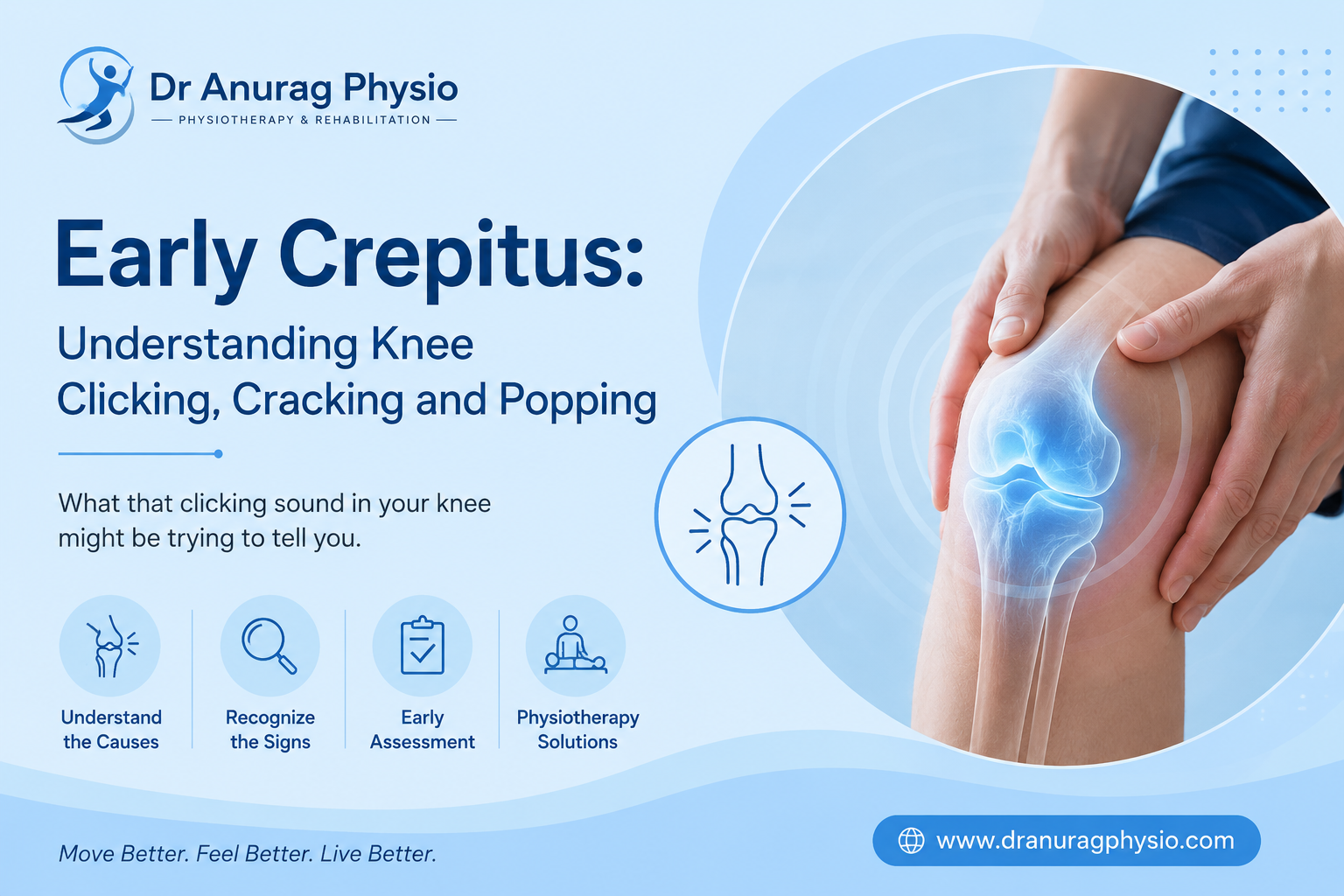
For someone who has recently noticed knee clicking, the more important question is not simply, “Why is my knee making a sound?” It is whether the sound is accompanied by other symptoms such as pain, swelling, stiffness, instability, locking or difficulty moving the knee.
Book Appointment
This distinction matters because knee sounds can occur in several different situations. For example, knee clicking without pain may be relatively harmless, whereas clicking accompanied by pain or a knee that locks or gives way deserves professional assessment.
People in Mahadevapura and other parts of Bangalore may also notice knee sounds after starting a new exercise routine, increasing running or gym activity, recovering from an injury, or spending long periods being inactive.
This blog explains what early crepitus can mean, when knee sounds may simply be a normal finding, what symptoms should prompt an assessment, and how physiotherapy may fit into care when an underlying movement or musculoskeletal problem is present.
2. Understanding Knee Crepitus: What Causes Knee Clicking and Cracking?
What is knee crepitus?
Knee crepitus refers to noises or sensations that occur as the knee moves. Patients may describe it as:
- Clicking
- Cracking
- Popping
- Grinding
- Grating
- Crunching
- A rubbing or rough sensation
The sound itself does not provide enough information to identify its cause.
A person can have knee cracking without pain, while another person may have similar sounds together with pain, swelling or restricted movement.
Is knee clicking without pain normal?
In many cases, yes. Painless clicking or creaking can occur in otherwise healthy knees and does not necessarily indicate joint damage. NHS musculoskeletal guidance notes that clicking and creaking are common and are rarely a sign of harm when occurring without concerning symptoms.
However, the presence of other symptoms changes the situation.
Symptoms worth paying attention to
If knee popping without pain occurs occasionally and your knee functions normally, it may not require treatment.
You should consider professional assessment if knee sounds occur with:
- Persistent or increasing knee pain
- Swelling
- Significant stiffness
- Difficulty bending or straightening the knee
- A sensation of locking
- The knee giving way
- Reduced ability to walk or exercise
- Symptoms following a significant injury
- Increasing difficulty using stairs, squatting or running
A meniscus injury, for example, can cause pain, swelling, difficulty moving the knee and clicking or crunching sensations, particularly after a twisting injury.
Why does my knee click when I bend it?
There are several possible reasons for a clicking or grinding sensation during knee movement. These can include normal joint sounds, movement of tissues around the joint, changes associated with the kneecap, previous injury or other musculoskeletal conditions.
A sound alone cannot establish the cause.
If you notice clicking sound in knee movement together with pain, swelling or functional limitations, an assessment can help determine whether further evaluation is appropriate.
Practical precautions
If your knee is making noises but otherwise feels normal:
- Continue normal movement within your comfort level.
- Avoid suddenly increasing exercise intensity.
- Build strength and activity gradually.
- Pay attention to new pain, swelling or instability.
- Avoid repeatedly forcing the knee to crack.
- Seek professional advice if symptoms persist or interfere with activities.
3. What Are the Treatment Options for Knee Crepitus?
Treatment is not usually directed at the sound itself.
The appropriate approach depends on whether there is an underlying condition, injury, weakness, movement limitation or pain.
Non-surgical and conservative care
When knee crepitus occurs alongside a treatable musculoskeletal problem, conservative management may include:
- Physiotherapy assessment
- Strengthening exercises
- Mobility exercises
- Movement retraining
- Balance and coordination exercises
- Activity modification
- Gradual return to exercise
- Education about load management
For example, if knee grinding occurs alongside anterior knee pain, rehabilitation may focus on factors such as strength, movement control and activity tolerance. NHS musculoskeletal resources note that crepitus can occur with patellofemoral pain and does not necessarily mean that movement is damaging the knee.
You can learn more about the clinic’s approach to knee problems on the Knee Pain Treatment in Bangalore page.
For patients recovering from an injury, rehabilitation may also involve progressive strengthening and functional retraining. See Sports Injury Physiotherapy in Bangalore for information about sports rehabilitation.
When can surgery or specialist treatment be considered?
Surgery is not performed simply because a knee makes a sound.
If an assessment identifies a structural problem such as a significant meniscus or ligament injury, treatment depends on the specific injury, symptoms, functional limitations and clinical findings.
Some injuries can be managed conservatively, while others may require assessment by an orthopedic specialist and potentially an intervention.
If surgery is required, physiotherapy can form part of the recovery process before and after the procedure. Dr Anurag Physio provides information about physiotherapy after surgery and progressive rehabilitation.
4. Cost and Other Considerations for Knee Crepitus
The cost of evaluating or managing knee symptoms depends on what is actually causing the problem.
A person with occasional painless knee popping may not need the same level of investigation or treatment as someone with persistent pain, swelling or a history of injury.
Factors that can influence overall healthcare costs include:
- Initial clinical assessment
- Number of physiotherapy sessions required
- Complexity of the condition
- Whether rehabilitation is required after surgery
- Whether specialist consultation is needed
- Whether diagnostic imaging is clinically indicated
- Duration of rehabilitation
- Home-based versus clinic-based care
Not everyone with knee crepitus needs an X-ray, MRI or other imaging. The need for investigations depends on the clinical assessment and symptoms.
Costs vary from patient to patient and should be discussed with the healthcare provider before treatment begins. A noisy knee by itself should not be used as a reason to pursue unnecessary investigations or treatment.
5. Why Consider Dr Anurag Physio for Knee Rehabilitation?
If knee clicking is accompanied by pain, weakness, stiffness or reduced function, an assessment can help determine whether rehabilitation may be appropriate.
Dr Anurag Physio describes its approach around clinical assessment, personalised rehabilitation and progressive exercise. Its services include sports injury rehabilitation, orthopedic physiotherapy and movement-focused rehabilitation.
Individual assessment
Knee symptoms can have different causes. A physiotherapist can assess relevant aspects such as:
- Knee movement
- Muscle strength
- Functional movement
- Balance
- Activity tolerance
- Movement patterns
- Symptoms during specific activities
Exercise-based rehabilitation
Where appropriate, rehabilitation may include progressive strengthening, mobility work and functional exercises.
Sports and orthopedic rehabilitation
Dr Anurag Physio provides sports and orthopedic rehabilitation, including rehabilitation for knee injuries and post-surgical conditions.
Progressive recovery
The goal is not simply to make the knee quieter. If a problem is present, rehabilitation focuses on improving the functions that matter to the patient, such as walking, climbing stairs, exercising or returning to sport.
The practice currently lists physiotherapy centres including MakeMeFit in Mahadevapura and Moventra in Varthur, serving patients across stated Bangalore service areas.
For patients whose knee symptoms are associated with athletic activity, the Sports Physiotherapy for Runners in Bangalore page provides additional information about running rehabilitation.
For patients recovering from joint replacement, see Best Physiotherapy for Knee Replacement Recovery.
7. When Should You Get Knee Clicking Assessed?
Book Appointment
If your knee has started making new sounds and you are unsure whether they are normal, pay attention to what happens alongside the sound.
An isolated, painless knee sound may not require treatment. However, persistent pain, swelling, locking, giving way, significant stiffness or difficulty bearing weight should be professionally assessed. NHS guidance specifically recommends seeking medical advice for a painful click, locking or giving-way knee, while noting that painless clicking can be normal.
If you are in Mahadevapura, Bangalore, you can contact Dr Anurag Physio to discuss whether a physiotherapy assessment is appropriate for your symptoms.
Dr Anurag Physio
Mahadevapura, Bangalore
Phone: +91 91480 17070