Knee replacement surgery can relieve severe knee pain and improve mobility, but surgery itself is only one part of the recovery process. Knee replacement physiotherapy plays an important role in helping you regain knee movement, muscle strength, balance and confidence with everyday activities.
The right rehabilitation program depends on your age, overall health, pre-surgery strength, type of knee replacement, surgical technique, pain and swelling, mobility before surgery and your surgeon’s instructions.
Dr Anurag Physio’s current post-surgical rehabilitation information describes a staged approach that includes pain and swelling management, range-of-motion exercises, strengthening, walking training, balance work and progressive functional recovery.
Quick answer
Most patients begin rehabilitation very early after knee replacement, often during the initial hospital recovery period when medically appropriate. Early treatment usually focuses on safe movement, swelling management, knee mobility, muscle activation and walking.
As recovery progresses, therapy can move toward:
Mobility → Strength → Balance → Walking → Stairs → Functional activities → Higher-level exercise
Your recovery should be guided by your surgical protocol and individual progress rather than by another patient’s timeline.
Book Appointment
What Is Knee Replacement Physiotherapy?
Knee replacement physiotherapy is a structured rehabilitation program designed to help restore function after partial or total knee replacement.
It may help address:
- Knee stiffness
- Reduced knee bending
- Muscle weakness
- Difficulty walking
- Difficulty climbing stairs
- Balance problems
- Reduced endurance
- Fear of movement
- Difficulty returning to normal activities
The purpose is not simply to make the knee “feel better.”
The larger goal is to help you safely regain the movement and strength required for your daily life.
For an older adult, that may mean being able to walk independently, use stairs and perform household activities.
For a physically active person, it may also include returning to cycling, gym exercises, recreational activities or other appropriate forms of exercise.
Why Is Physiotherapy Important After Knee Replacement?
After surgery, pain and swelling can cause the muscles around the knee to become weak or difficult to activate.
You may also temporarily experience:
- Reduced knee flexion
- Difficulty straightening the knee
- Altered walking
- Thigh weakness
- Reduced balance
- Reduced confidence
- Stiffness after sitting
Without appropriate rehabilitation, these limitations can interfere with everyday function.
A structured program can progressively address:
- Pain and swelling
- Knee movement
- Muscle activation
- Strength
- Walking
- Balance
- Functional movement
- Long-term activity
Dr Anurag Physio’s current rehabilitation protocol describes these stages as progressive recovery rather than a one-size-fits-all treatment plan.
Before and After Knee Replacement Surgery
Good rehabilitation can begin before the operation.
Before Knee Replacement Surgery
Pre-operative physiotherapy, when appropriate, may focus on:
- Maintaining available knee movement
- Strengthening the quadriceps
- Strengthening the hamstrings and hip muscles
- Improving general fitness
- Learning walking aids
- Understanding post-operative exercises
- Preparing for the initial recovery phase
This is sometimes called prehabilitation.
The objective is to enter surgery with the best practical level of strength and mobility possible.
After Knee Replacement Surgery
After surgery, the priorities change.
Early rehabilitation may focus on:
- Safe movement
- Pain and swelling management
- Knee mobility
- Quadriceps activation
- Bed and chair transfers
- Walking
- Basic functional independence
Dr Anurag Physio currently describes early post-operative rehabilitation as including gentle range-of-motion work, quadriceps activation and walking support, followed by progressive strengthening and functional rehabilitation.
TKR Exercises: What Are They?
TKR exercises are exercises used during rehabilitation after total knee replacement.
The exact exercises and progression should be individualised.
Common categories may include:
1. Ankle Pumps
These involve repeated ankle movement and may be used during the early recovery period as part of a broader mobility program.
2. Quadriceps Activation
The quadriceps are important for knee stability, standing and walking.
After surgery, activating these muscles may initially be difficult.
3. Knee Flexion Exercises
Controlled knee-bending exercises may be introduced to gradually improve the available range of motion.
4. Knee Extension Exercises
Regaining the ability to straighten the knee is also an important rehabilitation goal.
5. Straight-Leg Exercises
When clinically appropriate, controlled leg-raising exercises can help develop lower-limb strength.
6. Sit-to-Stand Practice
This bridges the gap between exercise and everyday function.
7. Walking Exercises
Walking distance and support can be gradually progressed according to individual recovery.
8. Balance Exercises
As strength and mobility improve, balance training may become part of the program.
Knee Bending Exercises After Surgery
One of the most common concerns after knee replacement is difficulty bending the knee.
Knee bending exercises after surgery may be introduced progressively to improve flexion while respecting pain, swelling and surgical restrictions.
Depending on your rehabilitation stage, exercises may include:
- Assisted knee bends
- Heel slides
- Seated knee flexion
- Controlled cycling when appropriate
- Functional bending activities
The objective is controlled progress, not forcing the knee aggressively.
Excessive pressure or poorly controlled exercises may increase pain and swelling.
Your physiotherapist can determine the appropriate exercise range and progression.
Total Knee Replacement Exercises: A Stage-Wise Approach
Total knee replacement exercises should change as your recovery progresses.
Early Phase
The focus is generally on:
- Swelling management
- Gentle movement
- Muscle activation
- Safe transfers
- Walking
- Basic range of motion
Intermediate Phase
The program can progress toward:
- Strengthening
- Improved knee flexion and extension
- Longer walking
- Stair practice
- Balance
- Functional exercises
Advanced Phase
Depending on your goals, rehabilitation may include:
- Progressive resistance exercises
- Endurance activities
- Advanced balance
- Functional strengthening
- Cycling
- Activity-specific conditioning
Not everyone needs the same exercises at the same stage.
TKR Rehab Protocol: What Does It Mean?
A TKR rehab protocol is a structured rehabilitation plan following total knee replacement.
However, there is an important distinction between a general protocol and an individual rehabilitation program.
A protocol may provide general stages and precautions.
Your physiotherapist must still consider:
- Your age
- Medical history
- Surgical details
- Pre-operative mobility
- Muscle strength
- Pain
- Swelling
- Range of motion
- Walking ability
- Balance
- Functional goals
Therefore, a TKR physiotherapy protocol should be adapted rather than copied from another patient.
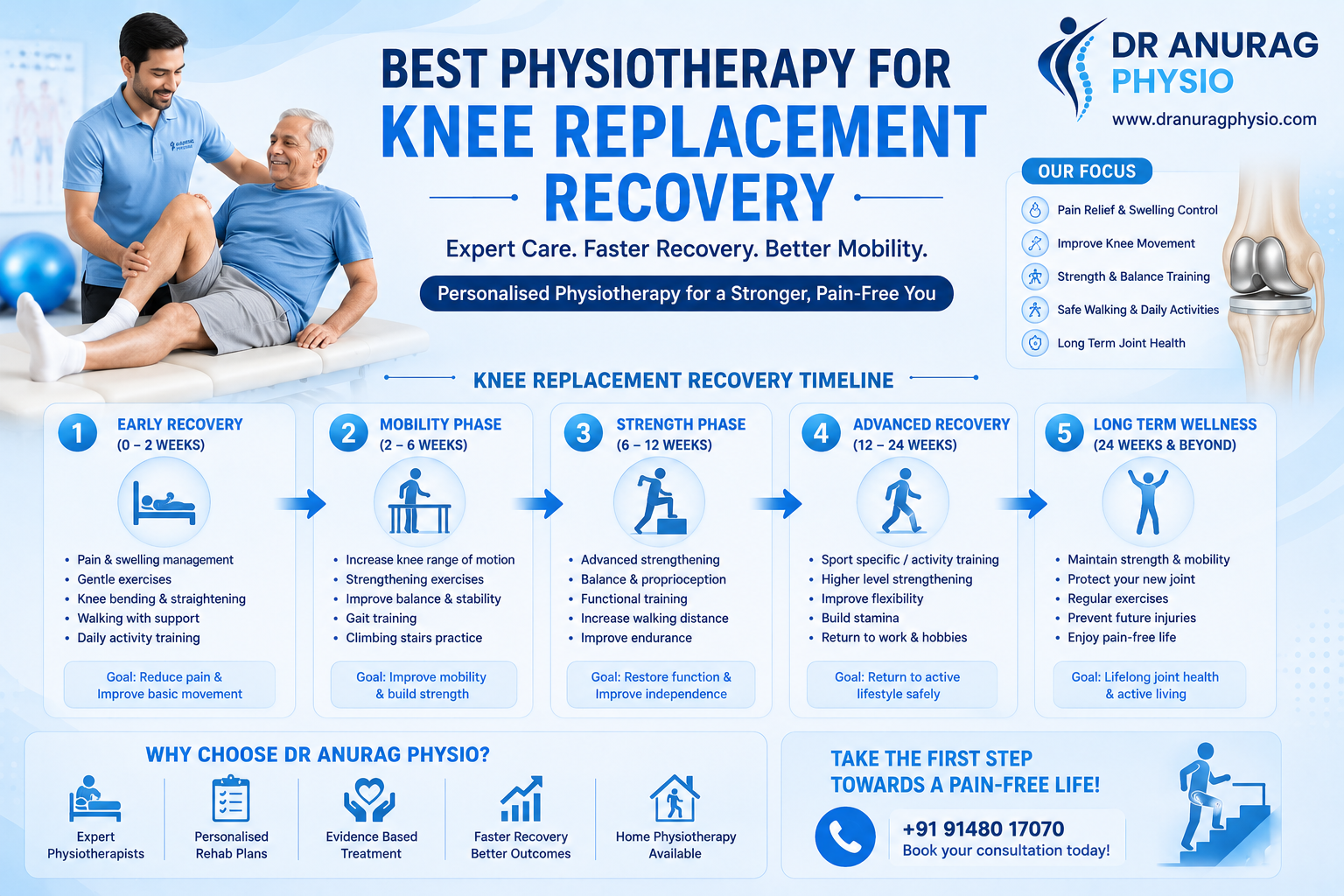
Knee Replacement Physiotherapy Timeline
Recovery varies considerably between patients.
A general framework can look like this:
| Recovery Stage | Main Rehabilitation Focus |
| Initial days | Pain, swelling, movement and safe walking |
| Early weeks | Knee mobility, muscle activation and walking |
| Following weeks | Strength, balance and functional movement |
| Later rehabilitation | Endurance, independence and activity progression |
| Longer term | Maintaining strength, mobility and appropriate activity |
These are broad rehabilitation stages rather than guaranteed deadlines.
Dr Anurag Physio’s current website states that many patients undergo structured therapy for approximately 8–12 weeks, although the actual duration varies according to the patient and recovery progress.
Knee Replacement Surgery Recovery Time
Knee replacement surgery recovery time varies from person to person.
Factors that may influence recovery include:
- Age
- Overall health
- Pre-surgery fitness
- Muscle strength
- Weight
- Balance
- Surgical complexity
- Pain and swelling
- Adherence to rehabilitation
- Previous mobility limitations
- Other medical conditions
Instead of asking only, “How many weeks until I recover?”, it can be more useful to track functional milestones.
For example:
Can I straighten my knee?
Can I bend it sufficiently for daily activities?
Can I walk safely?
Can I climb stairs?
Can I get up from a chair?
Has my strength improved?
These functional improvements provide more meaningful information than a calendar date alone.
Knee Replacement Recovery Time for Elderly Patients
Families often search for knee replacement recovery time for elderly patients because recovery can appear slower in older adults.
Age alone does not determine the outcome.
Recovery can also be influenced by:
- Pre-surgery activity level
- Muscle strength
- Balance
- General health
- Other joint problems
- Fear of falling
- Ability to perform exercises
- Support at home
- Nutrition and sleep
- Previous mobility
Older adults may benefit from rehabilitation that places additional attention on:
- Safe walking
- Balance
- Fall prevention
- Functional independence
- Transfers
- Stair training
- Strength maintenance
Dr Anurag Physio also provides home-based physiotherapy services, including post-surgical rehabilitation for patients who may have difficulty travelling after knee replacement.
Knee Operation Recovery Time: What Should You Expect?
People often use knee operation recovery time as a general term, but different knee operations have very different recovery pathways.
A total knee replacement is different from:
- ACL reconstruction
- Meniscus repair
- Fracture fixation
- Ligament repair
- Arthroscopy
- Cartilage procedures
Therefore, recovery expectations should be based on the actual operation rather than simply the word “knee surgery.”
How to Know If Your Knee Replacement Recovery Is Progressing
Look for gradual improvement in:
Knee Movement
You should progressively work toward the movement required for your daily activities.
Strength
The operated leg should gradually become stronger.
Walking
You may progress from assisted walking toward more independent walking according to your recovery.
Balance
Improved control can make standing and walking safer.
Function
Everyday activities should gradually become easier.
Confidence
Fear of movement should reduce as your strength and control improve.
If progress stops or symptoms significantly worsen, discuss the issue with your physiotherapist or surgical team.
Common Mistakes During Knee Replacement Recovery
1. Doing Too Much Too Soon
More exercise does not automatically mean faster recovery.
Excessive loading can increase pain and swelling.
2. Avoiding Movement Completely
Fear of movement can contribute to stiffness and weakness.
Your rehabilitation team can identify safe movement.
3. Comparing Yourself With Another Patient
Two people can have very different recovery patterns.
4. Stopping Physiotherapy When Pain Improves
Pain reduction does not necessarily mean strength and mobility are fully restored.
5. Ignoring Walking Mechanics
An altered walking pattern may continue even after pain improves.
6. Neglecting Strength
Knee mobility is important, but strength is also essential for walking, stairs and independence.
7. Following Random Online Exercises
Exercises suitable for one patient may not be appropriate for another.
When Should You Seek Professional Physiotherapy?
You should consider professional rehabilitation after knee replacement rather than relying only on unsupervised exercises.
A physiotherapist can help assess:
- Knee movement
- Strength
- Walking
- Balance
- Swelling
- Exercise technique
- Functional limitations
- Progression
Professional assessment is especially useful if you experience:
- Persistent stiffness
- Difficulty bending the knee
- Difficulty straightening the knee
- Ongoing weakness
- Difficulty walking
- Recurrent swelling
- Poor balance
- Fear of putting weight through the operated leg
- Slow functional progress
When Should You Contact Your Surgeon?
Physiotherapy does not replace medical review.
Contact your surgical team if you develop symptoms that concern you, particularly:
- Increasing wound redness
- Drainage from the surgical wound
- Fever
- Sudden severe pain
- Rapidly increasing swelling
- New or worsening calf pain or swelling
- New weakness or sensory changes
Sudden chest pain, severe breathing difficulty or other emergency symptoms require urgent medical attention.
Knee Replacement Physiotherapy at Dr Anurag Physio
Dr Anurag Physio provides orthopedic and post-surgical rehabilitation in Bangalore.
Its current post-surgery rehabilitation information describes:
- Pain and swelling management
- Range-of-motion exercises
- Quadriceps activation
- Walking training
- Strength rebuilding
- Balance correction
- Functional rehabilitation
- Progressive recovery monitoring
The clinic currently lists centres in Mahadevapura and Varthur, and its website also offers home-based physiotherapy services for post-surgical patients within its service area.
Phone: +91 91480 17070
What Makes a Good Knee Replacement Physiotherapy Program?
The best rehabilitation program is not necessarily the one that promises the fastest recovery.
Look for a program that provides:
Individual Assessment
Your treatment should begin with an assessment rather than a generic exercise sheet.
Progressive Exercise
Exercises should become more challenging as your strength and control improve.
Mobility Monitoring
Knee flexion and extension should be monitored as appropriate.
Strength Development
Quadriceps, hamstrings, hip and other supporting muscles may need progressive strengthening.
Functional Training
Your program should prepare you for actual activities such as walking, stairs and getting up from a chair.
Safety Monitoring
Pain, swelling, wound concerns and other symptoms should be monitored appropriately.
Goal-Based Rehabilitation
Your rehabilitation should reflect what you want to return to—whether that is independent walking, work, exercise or recreational activity.
Book appointment
Why Choose Dr Anurag Physio for Knee Replacement Rehabilitation?
Dr Anurag Physio describes its approach as evidence-based orthopedic and sports rehabilitation, with personalised programs based on clinical assessment and the patient’s recovery stage.
Personalised Rehabilitation
The clinic describes one-to-one treatment plans rather than a generic therapy approach.
Structured Recovery
Post-surgical rehabilitation is organised into stages involving mobility, strength, balance and functional recovery.
Orthopedic Physiotherapy Expertise
Knee replacement rehabilitation is part of the clinic’s orthopedic physiotherapy services.
Home Rehabilitation Option
For patients who find travelling difficult after surgery, the clinic provides home-based physiotherapy within its stated service area.
Meet Dr Anurag Gupta
Dr Anurag Gupta
Physiotherapist | Sports & Orthopedic Rehabilitation
Dr Anurag Gupta’s practice focuses on orthopedic physiotherapy, sports rehabilitation, post-surgical rehabilitation, movement restoration and functional recovery.
The clinic website describes his approach as being based on clinical assessment, evidence-based rehabilitation protocols and measurable recovery outcomes.
Practice: Dr Anurag Physio
Location: Bangalore, Karnataka
Phone: +91 91480 17070
For the doctor’s exact professional qualifications, registrations and certifications, only verified information should be added to the published profile.