The sports injury rehab recovery timeline depends on the type and severity of injury, the tissue involved, your activity level, previous injuries, treatment response and your return-to-sport goals.
Book Appointment
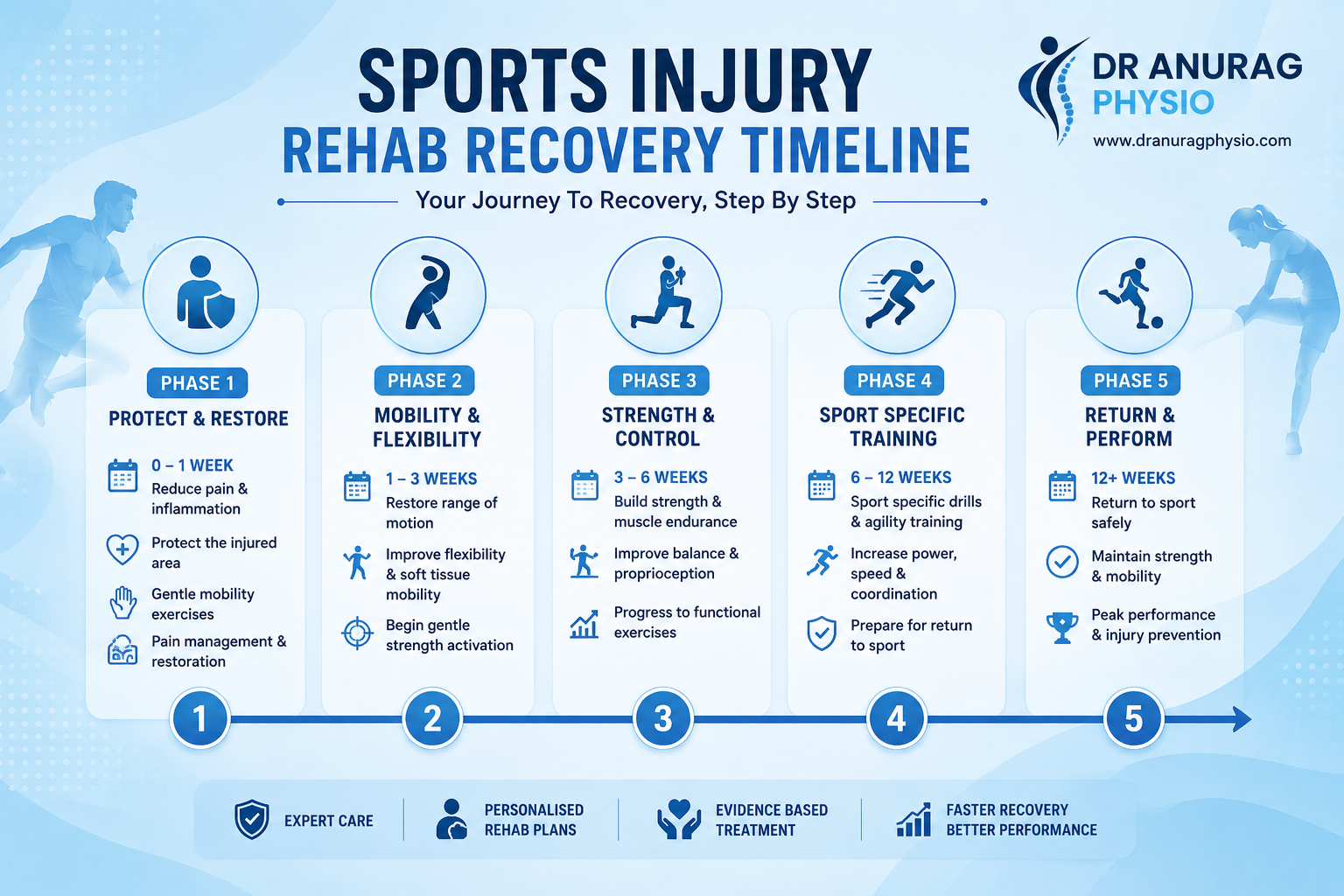
A mild muscle strain may improve over a few weeks, while ligament injuries, tendon problems, fractures, post-surgical conditions or recurrent injuries can require a much longer rehabilitation program.
Rather than following a fixed number of days, sports rehabilitation usually progresses through functional milestones:
- Pain and swelling control
- Restoring movement
- Rebuilding strength
- Improving balance and coordination
- Progressive sport-specific loading
- Return to training
- Return to competitive sport
- Injury prevention and performance maintenance
At Dr Anurag Physio, rehabilitation is personalised around the individual’s injury, movement limitations, sport, training demands and recovery goals.
What Is Sports Injury Rehabilitation?
Sports rehabilitation is a structured process that helps an injured athlete or active individual restore movement, strength, coordination and confidence after an injury.
It is not simply about reducing pain.
A complete rehabilitation program aims to help you:
- Restore normal joint and muscle movement
- Improve strength and endurance
- Rebuild balance and coordination
- Correct movement limitations
- Gradually tolerate increasing physical loads
- Return to exercise or sport safely
- Reduce the risk of reinjury
- Improve physical performance where appropriate
Sports rehab can be useful for recreational athletes, gym-goers, runners, footballers, cricketers, badminton players, cyclists and individuals who participate in regular fitness activities.
The exact rehabilitation approach should be determined after an appropriate clinical assessment.
Sports Injury Rehab Recovery Timeline: The Main Stages
There is no universal recovery calendar for every injury. However, most sports injuries and rehabilitation programs follow a progressive structure.
Stage 1: Assessment, Pain and Swelling Management
Typical focus: Early phase
The first stage is about understanding what happened and determining how much the injury is affecting movement and function.
A physiotherapy assessment may consider:
- How the injury occurred
- Location and nature of pain
- Swelling or bruising
- Joint movement
- Muscle strength
- Weight-bearing ability
- Balance
- Walking or running mechanics
- Previous injuries
- Current training demands
The goal is not to completely stop movement unless clinically necessary. Instead, rehabilitation should identify the appropriate level of activity that the injured tissue can safely tolerate.
Depending on the condition, treatment may include education, appropriate activity modification, gentle mobility work, therapeutic exercise and other physiotherapy techniques.
What should you expect?
Pain may still be present at this stage. The objective is to establish safe movement and prevent unnecessary loss of function while the tissue recovers.
Stage 2: Restore Mobility and Normal Movement
Typical focus: Early to intermediate phase
Once symptoms are sufficiently controlled, rehabilitation can progress toward restoring mobility.
For example, a person recovering from a knee injury may experience difficulty bending or straightening the knee.
Patients commonly describe this as:
- knee bending problem
- my knee hurts when I bend it and straighten it
- Stiffness after sitting
- Difficulty squatting
- Difficulty climbing stairs
- Reduced range of motion
Another common complaint is side knee pain when bending, which can have different causes depending on the location of pain, injury history and movement pattern.
The appropriate treatment depends on the underlying cause rather than the symptom alone.
Physiotherapy may include:
- Joint mobility exercises
- Flexibility work
- Controlled range-of-motion exercises
- Muscle activation
- Movement retraining
- Manual therapy where appropriate
- Gradual weight-bearing exercises
The goal is to restore useful movement without unnecessarily aggravating the injury.
Stage 3: Rebuild Strength and Capacity
Typical focus: Intermediate phase
Pain may decrease before the injured area has regained its previous strength.
This is one reason why returning to sport simply because you “feel better” can be premature.
Strength rehabilitation may progress from basic exercises to more demanding movements based on the individual’s tolerance.
Exercises may target:
- The injured muscle or joint
- Supporting muscle groups
- Core stability
- Lower-limb strength
- Upper-limb strength
- Hip and knee control
- Calf and ankle capacity
- Sport-specific movement patterns
The objective is to gradually increase the amount of load the body can tolerate.
A physiotherapist may monitor factors such as pain response, movement quality, strength differences and exercise tolerance before progressing the program.
Stage 4: Balance, Coordination and Neuromuscular Control
Typical focus: Intermediate to advanced phase
Strength alone is not always enough for a safe return to sport.
Athletes also need to control their body during:
- Landing
- Cutting
- Turning
- Accelerating
- Decelerating
- Jumping
- Single-leg movements
- Sudden changes in direction
Some patients may experience losing balance while walking after an injury, particularly when pain, weakness, reduced joint control or altered movement patterns affect normal function.
In appropriate cases, physiotherapy may incorporate balance and neuromuscular exercises.
People searching for balance disorder treatment should understand that balance problems have many possible causes. Persistent, unexplained or sudden balance problems require proper medical assessment rather than assuming they are simply related to a sports injury.
Stage 5: Functional and Sport-Specific Rehabilitation
Typical focus: Advanced rehabilitation
This is where rehabilitation begins to resemble the demands of the athlete’s actual activity.
For example, a runner may gradually progress through:
Walking → jogging → running → acceleration → change of direction → sport-specific drills
A football player may need progressive:
- Sprinting
- Cutting
- Kicking
- Jumping
- Deceleration
- Direction changes
- Ball-related movements
A badminton player may need:
- Lateral movement
- Lunges
- Jumping
- Quick acceleration
- Deceleration
- Repeated changes of direction
This stage is an important part of athletic care and rehabilitation because returning to normal daily activity does not necessarily mean the body is ready for competitive sport.
Stage 6: Return to Training
Typical focus: Late rehabilitation
Returning to training should generally be gradual.
Instead of immediately returning to the previous training volume, rehabilitation may progress through controlled increases in:
- Duration
- Intensity
- Speed
- Resistance
- Frequency
- Sport-specific workload
Your response during and after training matters.
If symptoms repeatedly increase after progressing activity, the rehabilitation plan may need modification.
A successful rehab injury program therefore does not simply ask, “Can you exercise?”
It asks:
Can you tolerate the specific demands of your sport repeatedly and safely?
Stage 7: Return to Sport
Return to sport is a progression rather than a single day on the calendar.
Before returning to full competition, a physiotherapist may consider:
- Pain levels
- Range of motion
- Strength
- Power
- Balance
- Movement quality
- Sport-specific performance
- Training tolerance
- Confidence
- Previous injury history
The final decision can also depend on the type of injury and whether surgical or specialist medical care was required.
For some injuries, objective testing may be useful before unrestricted sports participation.
How Long Does Sports Injury Rehabilitation Take?
There is no single sports injury rehab recovery timeline that applies to every patient.
Recovery may take:
A few weeks
Some mild strains, minor overuse problems or uncomplicated soft-tissue injuries may improve within a relatively short period when appropriately managed.
Several weeks to a few months
More significant muscle injuries, tendon problems, joint injuries or persistent symptoms may require a longer rehabilitation program.
Several months or longer
Major ligament injuries, fractures, surgical procedures, complex injuries or recurrent problems may require prolonged rehabilitation before full sports participation.
The important point is that recovery time should be based on clinical and functional progress rather than a predetermined date.
What Can Make Sports Injury Recovery Slower?
Several factors may influence recovery.
1. Severity of the Injury
A minor strain and a significant ligament injury should not be expected to recover at the same rate.
2. Previous Injuries
Previous injuries may influence movement patterns, strength and confidence.
3. Returning Too Quickly
Increasing activity before adequate tissue and functional recovery may aggravate symptoms.
4. Insufficient Rehabilitation
Stopping rehabilitation immediately after pain decreases may leave unresolved strength or movement deficits.
5. Poor Load Management
Suddenly increasing running, gym training or sports volume can place excessive stress on recovering tissues.
6. Individual Recovery Factors
Sleep, general health, nutrition, training history and adherence to the rehabilitation program may influence recovery.
When Should You See a Physiotherapist for a Sports Injury?
Consider professional assessment if:
- Pain persists after an injury
- Swelling does not settle
- You cannot comfortably bear weight
- Joint movement remains restricted
- The joint feels unstable
- Strength has noticeably decreased
- You repeatedly suffer the same injury
- You cannot return to your normal training
- Pain keeps returning when activity increases
- Your movement or balance has changed
For severe injuries, significant trauma, suspected fractures, major swelling, deformity or neurological symptoms, medical evaluation should not be delayed.
Sports Medicine Physiotherapy and Rehabilitation at Dr Anurag Physio
At Dr Anurag Physio, rehabilitation focuses on assessment, progressive exercise and functional recovery rather than relying only on temporary symptom relief.
The clinic’s sports rehabilitation services include rehabilitation approaches for:
- ACL and ligament injuries
- Muscle strains
- Sports-related knee problems
- Shoulder injuries
- Joint injuries
- Mobility limitations
- Return-to-sport programs
- Injury prevention
- Performance-focused rehabilitation
The clinic describes its approach as evidence-based and personalised, with rehabilitation plans adapted to the patient’s condition, activity level and goals.
Dr Anurag Gupta is presented on the clinic website as a senior/consultant physiotherapist with expertise in sports rehabilitation, orthopedic physiotherapy, movement restoration and dry needling. The website currently states 10+ years of clinical experience and 1000+ successful recoveries. These figures should be periodically verified before publication or whenever the page is updated.
Can Dry Needling Help During Sports Rehabilitation?
Dry needling physiotherapy may be used as one component of rehabilitation when clinically appropriate.
Dry needling involves the use of fine needles to target selected muscular or myofascial areas. It should not be considered a standalone replacement for progressive rehabilitation.
Depending on the patient’s condition, a physiotherapist may combine needling with:
- Therapeutic exercise
- Strength training
- Mobility work
- Manual therapy
- Movement retraining
- Functional rehabilitation
Needling physiotherapy should be selected based on the clinical assessment rather than simply because it is advertised as an advanced treatment.
Similarly, needle therapy should not be presented as a universal treatment for every sports injury.
Why Progressive Rehabilitation Is Better Than a Fixed Recovery Date
One of the biggest mistakes athletes make is treating recovery as a countdown.
For example:
“My injury happened four weeks ago, so I should be ready to play now.”
That assumption may not be appropriate.
Two people with similar injuries can recover at different rates because their injury severity, strength, training demands, previous injuries and response to rehabilitation can differ.
A better approach is to progress according to meaningful milestones:
Pain control → Mobility → Strength → Balance → Functional loading → Sport-specific drills → Training → Return to sport
This approach supports safer progression while allowing the rehabilitation program to be adjusted when symptoms or performance indicate that a change is needed.
Sports Rehabilitation for Different Athletes
Runners
Rehabilitation may focus on running mechanics, strength, impact tolerance, cadence, endurance and gradual mileage progression.
Gym Enthusiasts
The program may focus on restoring strength while modifying exercises that aggravate the injury.
Football and Cricket Players
Rehabilitation may require sprinting, acceleration, deceleration, jumping and change-of-direction training.
Badminton and Tennis Players
Lateral movement, lunging, quick direction changes and repeated loading may be important.
Recreational Athletes
The goal may be to return safely to a favourite activity rather than competitive sport.
The rehabilitation goal should therefore be based on what you need to do, not just what the injury is called.
What You Can Do During Sports Injury Recovery
Your actions outside physiotherapy sessions can influence the rehabilitation process.
Follow your prescribed exercise program
Perform exercises according to the recommended frequency and technique.
Avoid sudden increases in training
Do not jump directly from limited activity to your previous training volume.
Track your symptoms
Notice how your body responds during and after exercise.
Prioritise sleep and recovery
Adequate recovery supports your ability to train and rehabilitate consistently.
Communicate changes
Tell your physiotherapist if pain, swelling, weakness or movement limitations change.
Do not compare your timeline with another athlete
A teammate’s recovery does not necessarily predict yours.
Why Choose Dr Anurag Physio for Sports Rehabilitation in Bangalore?
Dr Anurag Physio focuses on personalised rehabilitation for athletes and active individuals.
Experienced Clinical Care
Dr Anurag Gupta is listed as having 10+ years of clinical experience in areas including orthopedic physiotherapy and sports rehabilitation.
1000+ Successful Recoveries
The clinic currently states 1000+ successful recoveries on its website. This figure should be kept updated and verified before continued use.
Personalised Rehabilitation
Treatment plans are developed around the patient’s condition, movement limitations, activity requirements and recovery objectives rather than applying one generic protocol.
Sports-Focused Approach
The rehabilitation approach can progress from symptom management to strength, functional movement and sport-specific activity.
Evidence-Based Rehabilitation
The clinic states that its treatment approach uses evidence-based rehabilitation protocols and structured assessment.
Physiotherapy Centres and Areas Served in Bangalore
Dr Anurag Physio currently lists rehabilitation services across several Bangalore locations, including:
- Whitefield
- Varthur
- Mahadevapura
- Marathahalli
- Sarjapur Road
- Bellandur
- HSR Layout
- Electronic City
- JP Nagar
- Indiranagar
- Nearby Bangalore areas
The website currently lists centres including MakeMeFit – Mahadevapura and Moventra – Varthur.
For the most current clinic location, appointment availability and service area, patients should contact the clinic directly.
Book Appointment
Phone: +91 91480 17070
Meet Dr Anurag Gupta
Dr Anurag Gupta
Senior/Consultant Physiotherapist | Bangalore
Dr Anurag Gupta’s clinical focus includes:
- Sports rehabilitation
- Orthopedic physiotherapy
- Sports injury rehabilitation
- Movement restoration
- Dry needling
- Fitness and performance rehabilitation
- Musculoskeletal rehabilitation
The clinic website currently identifies Dr Anurag Gupta as an experienced physiotherapist and states 10+ years of clinical experience and 1000+ successful recoveries.