An ACL injury can change the way you walk, exercise, work and participate in sport. If you have undergone ACL reconstruction, the operation is only one part of the recovery process. Your knee still needs progressive rehabilitation to restore movement, strength, control and confidence.
ACL rehab physiotherapy in Bangalore focuses on helping you progress through rehabilitation according to your symptoms, surgery status, physical capacity and activity goals.
Whether you are recovering after ACL reconstruction, preparing for surgery, managing an ACL injury conservatively or working toward returning to sport, rehabilitation should be individually planned rather than based only on a fixed number of weeks.
Dr Anurag Physio provides sports and orthopedic physiotherapy in Bangalore, including rehabilitation for sports injuries and post-surgical recovery.
Book Appointment
Quick Answer
ACL rehabilitation typically progresses through stages rather than following one identical program for everyone.
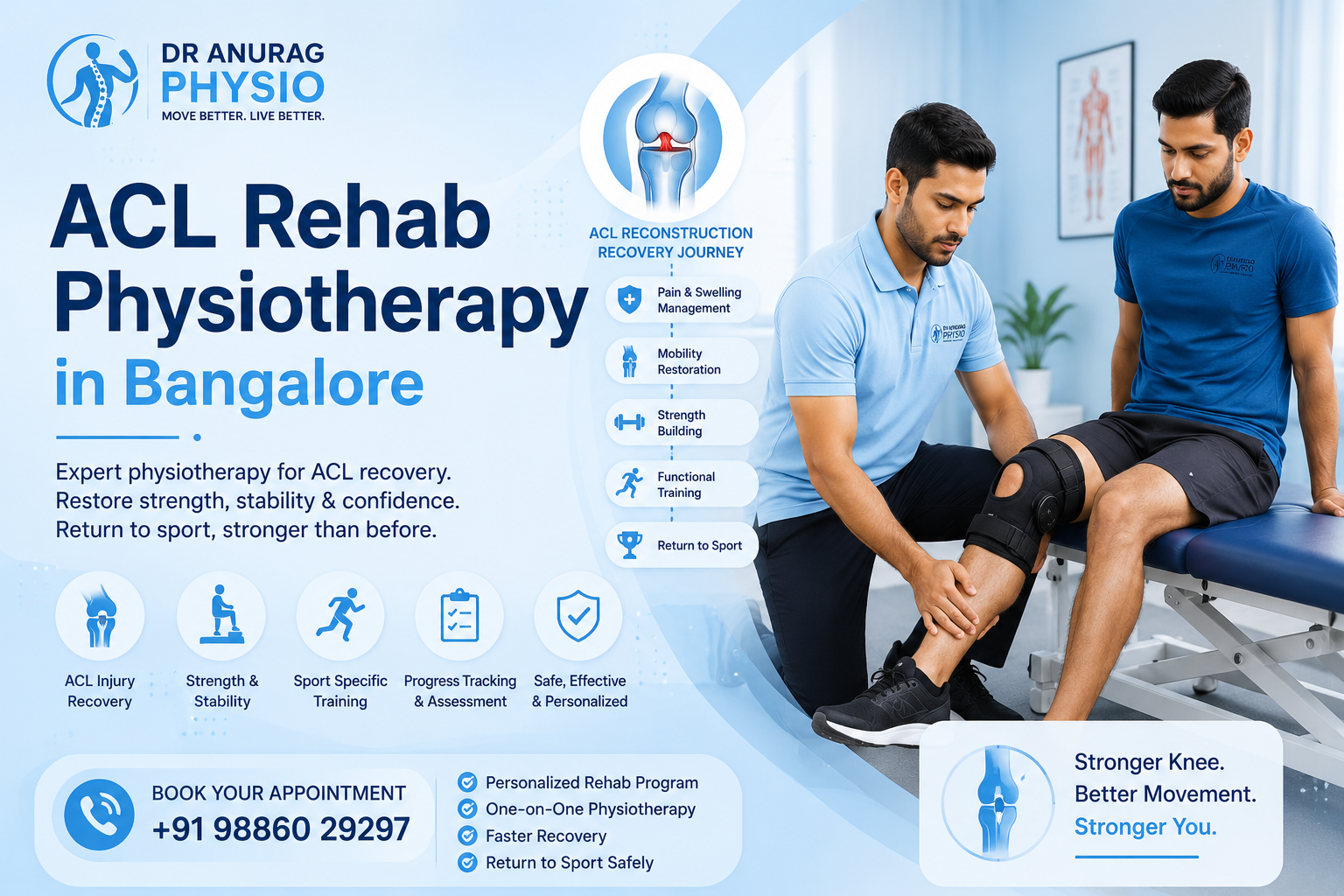
Depending on your condition, rehabilitation may include:
- Pain and swelling management
- Knee mobility
- Strengthening
- Quadriceps rehabilitation
- Hamstring and hip strengthening
- Balance and neuromuscular training
- Walking and movement retraining
- Running progression
- Functional exercises
- Sport-specific rehabilitation
- Return-to-sport testing
The progression should be guided by clinical findings and functional milestones.
What Is ACL Rehabilitation?
The anterior cruciate ligament (ACL) is one of the major stabilising ligaments of the knee.
An ACL injury can occur during:
- Sudden changes of direction
- Landing from a jump
- Pivoting
- Rapid deceleration
- Contact sports
- Skiing or other activities involving rotational forces
ACL rehabilitation aims to restore the physical qualities required for everyday activities and, where appropriate, sports participation.
These can include:
Mobility → Strength → Balance → Neuromuscular control → Running capacity → Sport-specific function
Rehabilitation requirements differ depending on whether you have had reconstruction, are being treated without surgery, or have additional injuries such as a meniscus injury.
Who Needs ACL Physiotherapy?
You may benefit from ACL rehabilitation if you:
- Have recently injured your ACL
- Are preparing for ACL surgery
- Have undergone ACL reconstruction
- Are returning to exercise after surgery
- Have persistent knee weakness
- Have difficulty with stairs
- Have reduced knee movement
- Feel instability during activity
- Want to return to running
- Want to return to sport
- Have an ACL injury being managed without surgery
Your rehabilitation plan should be based on your specific diagnosis and goals.
ACL Physiotherapy Bangalore: What Does Treatment Include?
When people search for ACL physiotherapy Bangalore, they may be looking for exercises, pain relief or guidance after surgery.
A comprehensive rehabilitation program can include several components.
Knee Range of Motion
Restoring appropriate knee movement is an important early rehabilitation goal.
Your physiotherapist may prescribe carefully selected mobility exercises based on your surgical status and current range of motion.
Strength Training
Strength deficits are common after ACL injury and reconstruction.
Rehabilitation may target:
- Quadriceps
- Hamstrings
- Glutes
- Calves
- Hip muscles
- Trunk muscles
Strength should be progressed gradually.
Balance Training
Balance and proprioception exercises can help improve control of the lower limb.
Examples may include:
- Single-leg balance
- Controlled step-downs
- Weight-shifting exercises
- Dynamic balance tasks
Neuromuscular Training
You may eventually progress to movements involving:
- Deceleration
- Landing
- Direction changes
- Single-leg control
- Jumping
The appropriate stage depends on your recovery.
ACL Rehabilitation Bangalore: A Milestone-Based Approach
ACL rehabilitation Bangalore should not be based solely on the calendar.
Two people who are both 12 weeks after surgery may have very different:
- Strength
- Swelling
- Knee movement
- Balance
- Functional ability
- Pain
- Confidence
Therefore, rehabilitation should use both time and objective progress.
A general progression may include:
Phase 1: Protect and Restore
Early goals may include:
- Managing swelling
- Regaining appropriate knee movement
- Activating muscles
- Improving walking
- Restoring basic function
Phase 2: Build Strength
The focus gradually shifts toward:
- Quadriceps strength
- Hamstring strength
- Hip strength
- Calf strength
- Single-leg control
Phase 3: Improve Functional Capacity
Exercises may become more demanding.
Examples include:
- Squats
- Lunges
- Step-ups
- Step-downs
- Single-leg exercises
Phase 4: Running Preparation
Before running, your physiotherapist may assess whether you have adequate:
- Strength
- Knee control
- Movement quality
- Functional capacity
Phase 5: Return to Sport
Sport-specific exercises can progressively introduce:
- Jumping
- Landing
- Acceleration
- Deceleration
- Cutting
- Direction changes
- Sport-specific drills
Clinical ACL rehabilitation guidance supports progressive, criterion-based rehabilitation rather than relying exclusively on time-based progression.
ACL Surgery Physiotherapy Bangalore
After ACL reconstruction, rehabilitation begins as part of the overall recovery pathway.
ACL surgery physiotherapy Bangalore may focus initially on restoring safe movement and gradually progressing toward higher-level function.
Early rehabilitation commonly considers:
- Swelling
- Pain
- Knee range of motion
- Muscle activation
- Walking
- Weight-bearing status
- Surgical restrictions
Your surgeon’s instructions should always take priority regarding weight-bearing, brace use, wound care and restrictions.
ACL Reconstruction Physiotherapy Bangalore
ACL reconstruction physiotherapy Bangalore should be individualised to the surgical procedure and patient’s recovery.
The rehabilitation plan may be affected by:
- Graft type
- Additional meniscus surgery
- Cartilage injury
- Other ligament injuries
- Surgical restrictions
- Pre-operative strength
- Post-operative swelling
- Patient goals
This is why copying another patient’s ACL exercise program can be inappropriate.
ACL Rehab After Surgery: What Should You Expect?
Recovery after ACL reconstruction is a gradual process.
Rather than expecting your knee to feel “normal” quickly, rehabilitation usually involves progressive improvements.
You may work toward:
Better Knee Movement
Regaining appropriate flexion and extension.
Reduced Swelling
Managing swelling so that exercise and movement can progress.
Improved Strength
Especially restoring quadriceps strength and lower-limb capacity.
Better Balance
Improving single-leg control and neuromuscular function.
Improved Confidence
Gradually becoming comfortable with more demanding movements.
Return to Running
Running should begin when appropriate criteria have been met, not simply because a certain number of weeks have passed.
Return to Sport
Sport-specific training should progressively reproduce the demands of your activity.
ACL Rehab Exercises
There is no universal list of exercises that every ACL patient should perform.
Depending on the stage of rehabilitation, exercises may include:
Early-Stage Exercises
- Quadriceps activation
- Heel slides
- Straight-leg raises where appropriate
- Gentle range-of-motion exercises
- Supported weight shifting
Strength Development
- Squats
- Leg press
- Step-ups
- Step-downs
- Split squats
- Hamstring strengthening
- Calf strengthening
- Hip strengthening
Advanced Rehabilitation
- Single-leg squats
- Hopping
- Jumping
- Landing drills
- Acceleration
- Deceleration
- Change-of-direction drills
Exercise selection should account for the surgical procedure, healing stage, symptoms and rehabilitation milestones.
How Long Does ACL Rehabilitation Take?
There is no single recovery timeline that applies to every patient.
Recovery can be influenced by:
- Type of injury
- Surgical procedure
- Additional injuries
- Graft type
- Age
- Strength
- Knee mobility
- Swelling
- Training history
- Rehabilitation consistency
- Sport requirements
A calendar can tell you how long it has been since surgery.
It cannot tell you whether your knee has regained sufficient strength and control for your next activity.
That is why criterion-based progression is important.
When Can You Start Running After ACL Reconstruction?
Running should not be started solely because you have reached a particular week after surgery.
Your physiotherapist may consider factors such as:
- Knee swelling
- Full or appropriate range of motion
- Quadriceps strength
- Single-leg control
- Functional performance
- Hopping or loading ability where appropriate
- Pain response
The exact criteria vary between rehabilitation programs and individual patients.
A gradual running progression can then be introduced when clinically appropriate.
Returning to Sport After ACL Surgery
Returning to sport is more than being able to jog without pain.
A sports rehabilitation program may progressively assess:
Strength
Can the injured leg produce sufficient force?
Single-Leg Control
Can you control your knee and hip during demanding movements?
Jumping and Landing
Can you absorb and produce force safely?
Change of Direction
Can you decelerate and change direction with appropriate control?
Sport-Specific Skills
Can you perform movements relevant to your sport?
Psychological Readiness
Do you feel confident and prepared to return?
Return-to-sport decisions should involve your healthcare team and relevant clinical criteria rather than relying on time alone.
ACL Rehabilitation Without Surgery
Not every ACL injury follows the same treatment pathway.
Some patients may be managed without reconstruction depending on factors such as:
- Knee stability
- Activity demands
- Associated injuries
- Patient goals
- Clinical assessment
Non-operative rehabilitation may focus on:
- Strength
- Knee control
- Balance
- Functional movement
- Activity modification
- Progressive return to desired activities
Whether non-operative treatment is appropriate should be determined with an orthopaedic professional and rehabilitation team.
ACL and Meniscus Rehabilitation
ACL injuries can occur alongside meniscus injuries.
When both structures are involved, rehabilitation may need additional considerations.
The program can be influenced by:
- Meniscus repair
- Weight-bearing restrictions
- Range-of-motion restrictions
- Surgical precautions
- Knee swelling
- Strength deficits
If you have undergone combined ACL and meniscus surgery, follow the specific restrictions provided by your surgeon and physiotherapist.
ACL Prehabilitation Before Surgery
Physiotherapy does not necessarily start after surgery.
Some patients may benefit from prehabilitation before ACL reconstruction.
Depending on the clinical situation, pre-operative rehabilitation may aim to improve:
- Knee movement
- Swelling control
- Quadriceps activation
- Lower-limb strength
- General physical capacity
- Understanding of post-operative exercises
Starting surgery with better physical preparation may make the early rehabilitation process easier for some patients.
Your orthopaedic surgeon should determine whether prehabilitation is appropriate for you.
Common Mistakes During ACL Recovery
Returning to Sport Too Quickly
Feeling better does not automatically mean the knee is ready for sport.
Focusing Only on the Knee
Hip, calf and trunk strength can also be important.
Ignoring Strength Differences
The injured leg may remain weaker even after pain has reduced.
Skipping Rehabilitation
Inconsistent rehabilitation can make progression more difficult.
Comparing Your Recovery With Someone Else’s
Every surgery and rehabilitation pathway is different.
Treating the Calendar as the Goal
Time is important, but function and clinical milestones matter too.
When Should You Contact Your Physiotherapist?
Contact your rehabilitation team if you experience:
- Increasing swelling
- Worsening pain
- Difficulty progressing exercises
- New instability
- Reduced knee movement
- Increasing difficulty walking
- Concerns about your rehabilitation progression
Following surgery, contact your surgical team promptly if you develop symptoms that may indicate a post-operative complication.
When Is Urgent Medical Assessment Needed?
Seek urgent medical attention for symptoms such as:
- Severe or rapidly increasing swelling
- Significant calf swelling or pain
- Chest pain
- Sudden shortness of breath
- New severe neurological symptoms
- Fever with significant wound problems
- Severe pain following a new injury
These symptoms should not be managed solely through routine physiotherapy.
Choosing ACL Rehabilitation in Bangalore
When looking for ACL rehabilitation Bangalore, don’t choose a provider only because they offer “ACL physiotherapy.”
Consider whether the service provides:
- Individual assessment
- Post-operative rehabilitation
- Progressive strengthening
- Balance and neuromuscular training
- Running progression
- Sport-specific rehabilitation
- Return-to-sport assessment
- Communication with your surgeon when required
The rehabilitation program should match your surgical status and activity goals.
Book Appointment
Why Choose Dr Anurag Physio for ACL Rehabilitation?
Sports Rehabilitation Focus
ACL recovery is closely connected to sports rehabilitation when the goal is to return to running or competitive activity.
Individualised Exercise Programs
Rehabilitation is adjusted according to your symptoms, strength, movement and functional progress.
Progressive Rehabilitation
Treatment can progress from basic movement and strengthening toward advanced functional and sport-specific exercises.
BookAppointment
Post-Surgical Rehabilitation
The practice provides rehabilitation for patients recovering from orthopedic procedures.
Bangalore-Based Physiotherapy
Dr Anurag Physio currently operates physiotherapy centres in Mahadevapura and Varthur, with services available across its stated Bangalore service areas.
Phone: +91 91480 17070
Meet Dr Anurag Gupta
Dr Anurag Gupta
Lead Physiotherapist | Sports & Orthopedic Rehabilitation
Dr Anurag Physio identifies Dr Anurag Gupta as its lead physiotherapist, with clinical focus areas including sports rehabilitation, orthopedic physiotherapy, musculoskeletal rehabilitation and post-surgical rehabilitation.
The practice currently states 10+ years of clinical experience and 1,000+ successful recoveries on its website. These claims should be reviewed and kept current before publication.
Practice: Dr Anurag Physio
Location: Bangalore, Karnataka
Phone: +91 91480 17070