Sitting at a desk for several hours every day can gradually affect the way your neck, shoulders, spine and lower back move.
You may notice:
- Lower back pain after sitting
- Stiffness when getting up from a chair
- Neck and shoulder discomfort
- Pain that increases toward the end of the workday
- Difficulty maintaining a comfortable sitting position
- Tingling or discomfort in the arm or hand
- Reduced flexibility
- Recurrent back pain after long working hours
If these symptoms keep returning, simply changing your chair or taking occasional painkillers may not address the underlying movement and strength issues.
Book Appointment
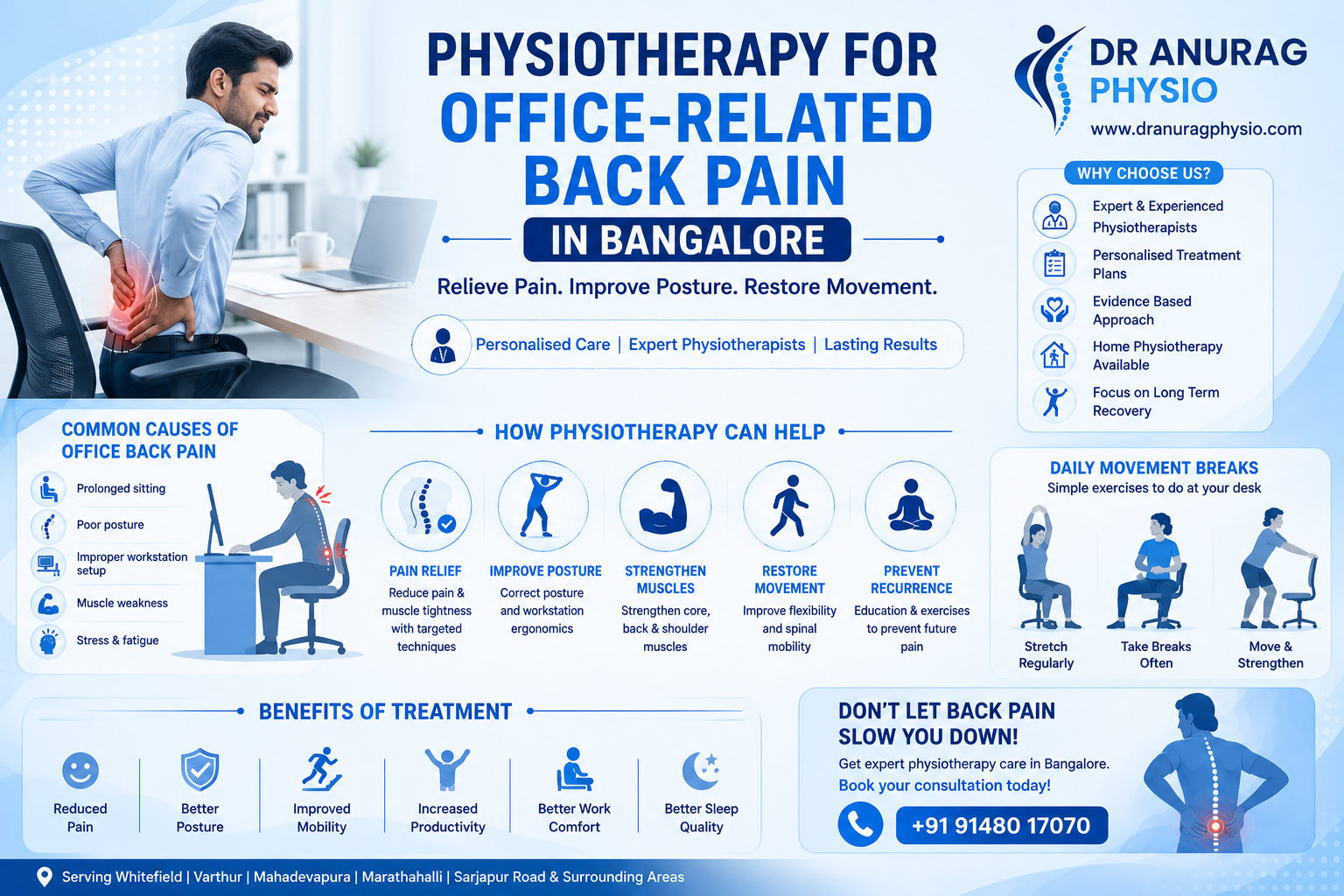
Physiotherapy for office-related back pain focuses on identifying contributing factors and improving movement, strength, posture, work habits and physical capacity.
Dr Anurag Physio provides musculoskeletal and orthopedic physiotherapy in Bangalore, including rehabilitation approaches for back and neck conditions. The clinic’s current website describes personalised assessment and exercise-based rehabilitation rather than a one-size-fits-all approach.
Why Does Office Work Cause Back Pain?
Office work does not automatically cause back pain, but prolonged sitting, limited movement and repetitive working positions can contribute to musculoskeletal discomfort.
Common contributing factors include:
Prolonged Sitting
Remaining in one position for hours can increase stiffness and reduce movement variety.
Poor Workstation Setup
A poorly positioned screen, keyboard or chair can encourage uncomfortable postures.
Limited Physical Activity
When most of the day is spent sitting, the body may receive less movement and strengthening stimulus.
Repetitive Movements
Repeated computer, mouse or phone use can contribute to neck, shoulder and upper-limb symptoms.
Stress and Fatigue
Work-related stress can affect muscle tension, sleep and pain perception.
Sudden Exercise
Someone who is inactive during the week but performs intense exercise on weekends may place a sudden load on the back.
What Does Office-Related Back Pain Feel Like?
Symptoms can vary from person to person.
You may experience:
- Aching in the lower back
- Stiffness
- Muscle tightness
- Pain after prolonged sitting
- Discomfort when standing after sitting
- Pain while bending
- Reduced movement
- Pain that improves after walking
- Recurrent episodes of back pain
Some people may also experience neck symptoms, particularly when working on a laptop or desktop for prolonged periods.
If pain travels into the leg or is associated with numbness, weakness or changes in bladder or bowel function, professional medical assessment is important.
When Should You See a Physiotherapist for Back Pain?
You may benefit from a professional assessment when:
- Back pain keeps returning
- Pain affects your workday
- You are avoiding normal activities
- Your movement has become restricted
- Sitting for long periods increases symptoms
- Exercise consistently aggravates your back
- You have developed weakness
- Pain is affecting sleep
- You are relying repeatedly on pain medication
- Symptoms have not improved as expected
A physiotherapist can assess movement, strength, flexibility, functional limitations and contributing factors before developing a treatment plan.
What Is Spine Physiotherapy?
Spine physiotherapy focuses on rehabilitation of movement and function related to the spine and surrounding muscles and joints.
Depending on your condition, treatment may include:
- Exercise therapy
- Mobility exercises
- Strengthening
- Core training
- Postural education
- Manual therapy where appropriate
- Movement retraining
- Ergonomic advice
- Functional rehabilitation
The objective is not to maintain a “perfect posture” all day.
Instead, treatment should help you develop the ability to move comfortably, tolerate different positions and manage your workload.
Back Pain Treatment in Bangalore: What Does Physiotherapy Involve?
If you search for back pain treatment in Bangalore, you may find many different treatment options.
Physiotherapy generally begins with an assessment.
Your physiotherapist may ask about:
- When the pain started
- Your daily working routine
- Sitting duration
- Sleep
- Exercise habits
- Previous injuries
- Pain triggers
- Pain-relieving activities
- Numbness or weakness
- Workstation setup
- Your physical goals
The physical assessment may include:
- Spinal movement
- Hip movement
- Muscle strength
- Flexibility
- Functional movement
- Balance
- Neurological screening where appropriate
The resulting treatment plan should be based on the findings rather than on the word “back pain” alone.
Exercises for Office-Related Back Pain
Exercise selection should depend on your symptoms and physical assessment.
Common categories may include:
1. Mobility Exercises
These may help restore comfortable movement after prolonged periods of sitting.
2. Core Strengthening
The trunk muscles contribute to the body’s ability to control movement and tolerate physical activity.
3. Hip Strengthening
Hip strength and movement can be relevant to lower-limb and trunk function.
4. Postural Endurance
The goal is not to hold one rigid posture but to develop the capacity to maintain and change positions comfortably.
5. Walking
Regular movement breaks and walking can help reduce the amount of uninterrupted sitting.
6. Functional Strengthening
Exercises can be progressed toward activities required at home, work or during exercise.
If a particular exercise increases your symptoms significantly, it should be reassessed rather than repeatedly performed because it appears in an online exercise list.
How Often Should You Move During Office Hours?
One of the most practical strategies for desk workers is to avoid remaining in the same position for excessively long periods.
Try to incorporate movement into your workday by:
- Standing during suitable tasks
- Walking during breaks
- Changing sitting position
- Performing brief mobility movements
- Avoiding unnecessary uninterrupted sitting
- Taking calls while standing or walking when appropriate
- Alternating between tasks
The aim is not to find a single “perfect” sitting posture.
Movement variety matters.
How to Set Up Your Office Workstation
A physiotherapist can help you individualise your workstation, but general considerations include:
Monitor
Position the screen so you do not need to repeatedly bend or rotate your neck.
Chair
Use a chair that provides appropriate support and allows your feet to rest comfortably.
Keyboard and Mouse
Keep frequently used devices positioned so that your shoulders do not remain unnecessarily elevated.
Laptop
If you work on a laptop for extended periods, consider an external keyboard and mouse with a suitable screen height.
Phone
Avoid repeatedly holding your phone between your shoulder and ear.
Good ergonomics should support comfortable movement rather than encourage rigid posture throughout the day.
Back Pain From Sitting vs. Other Causes
Not every case of back pain is caused by office work.
Back pain can also be associated with:
- Muscle strain
- Disc-related problems
- Joint irritation
- Previous injury
- Reduced strength
- Hip movement limitations
- Occupational loading
- Sports injuries
- Degenerative changes
- Inflammatory conditions
- Other medical conditions
This is why a proper assessment is more useful than assuming that your chair is the only cause.
What About Neck Pain From Office Work?
Desk workers frequently experience neck discomfort alongside back pain.
Long periods of laptop or screen use can contribute to:
- Neck stiffness
- Shoulder tension
- Headaches
- Reduced neck movement
- Upper-back discomfort
Persistent neck symptoms may require assessment for conditions such as cervical spondylosis.
Cervical Spondylosis Physiotherapy
Cervical spondylosis physiotherapy may be considered when neck symptoms are related to degenerative changes and associated movement or functional limitations.
Depending on the individual, rehabilitation may include:
- Neck mobility exercises
- Upper-back mobility
- Strengthening
- Postural endurance
- Shoulder-blade control
- Ergonomic modifications
- Activity management
The presence of degenerative changes on an imaging report does not automatically mean that every symptom is caused by those changes.
A clinical assessment helps put imaging findings into context.
Cervical Pain Symptoms in Hindi
People searching for cervical pain symptoms in Hindi commonly want simple information about neck-related discomfort.
Common symptoms may include:
- गर्दन में दर्द — neck pain
- गर्दन में अकड़न — neck stiffness
- कंधे में दर्द — shoulder pain
- गर्दन घुमाने में परेशानी — difficulty moving the neck
- सिरदर्द के साथ गर्दन में दर्द — headache associated with neck discomfort
- हाथ में झनझनाहट — tingling in the hand or arm
Persistent pain, significant weakness, numbness or symptoms affecting function should be assessed by a qualified healthcare professional rather than self-diagnosed from an online symptom list.
What If Back Pain Is Accompanied by Leg or Calf Pain?
Some people search for the calf muscle pain reasons when they experience leg discomfort alongside back problems.
Calf pain can have many causes, including:
- Muscle strain
- Overuse
- Exercise-related soreness
- Tendon problems
- Nerve-related symptoms
- Circulatory problems
- Other medical conditions
New calf swelling, warmth, redness or significant unexplained calf pain—particularly after surgery, prolonged immobility or long travel—should receive prompt medical assessment rather than being assumed to be a physiotherapy problem.
Can Physiotherapy Help With Other Office-Related Problems?
Yes, physiotherapy may address several musculoskeletal conditions associated with desk-based work.
Carpal Tunnel Syndrome
Repetitive hand and wrist use can be associated with symptoms such as:
- Hand tingling
- Numbness
- Night-time symptoms
- Grip difficulty
Treatment for carpal tunnel syndrome depends on the severity and underlying cause.
Therapy for carpal tunnel syndrome may involve education, activity modification, nerve and tendon-related exercises where appropriate, ergonomic changes and other conservative rehabilitation strategies.
Persistent neurological symptoms should be assessed appropriately.
Vertigo and Office Work
Some patients also search for vertigo treatment when they experience dizziness while working at a computer.
Vertigo is not simply another form of neck pain.
It can have multiple causes, including vestibular disorders and other medical conditions.
Some forms of dizziness may respond to vestibular rehabilitation, while others require medical evaluation.
If you experience:
- Sudden severe dizziness
- New neurological symptoms
- Difficulty speaking
- Severe headache
- Fainting
- New weakness
- Difficulty walking
seek urgent medical assessment.
Cupping Therapy for Back Pain
People searching for cupping therapy near me may be interested in complementary approaches for muscle discomfort.
Cupping may be used by some practitioners as an adjunctive treatment, but it should not replace appropriate assessment, exercise therapy or medical care when indicated.
If used, it should be incorporated into an overall rehabilitation plan based on the individual’s condition.
Treatment should not be marketed as a guaranteed cure for chronic back pain.
Lymphatic Drainage Massage
Lymphatic drainage massage is a specialised gentle massage technique intended to support lymphatic fluid movement.
It is different from standard massage and different from treatment for ordinary office-related back pain.
Lymphatic drainage massage therapy may be appropriate in selected situations, such as certain types of swelling or conditions where lymphatic management is clinically indicated.
It should not automatically be considered a treatment for every type of back pain.
If you have unexplained swelling, persistent limb swelling or sudden swelling, medical assessment may be necessary before massage-based treatment.
Physiotherapy for Back Pain Near Me in Bangalore
If you are searching for physiotherapy for back pain near me, location is convenient—but proximity should not be the only factor.
Consider whether the clinic provides:
- Individual assessment
- Evidence-informed rehabilitation
- Exercise-based treatment
- Progress monitoring
- Ergonomic advice
- Appropriate referral when symptoms require medical evaluation
The same applies when searching for back pain therapy near me or back pain physiotherapy near me.
The most appropriate treatment depends on your symptoms and clinical findings.
How to Find a Physiotherapy Clinic Near Me
People often search for physiotherapy near me or physiotherapy clinic near me when pain begins affecting their daily routine.
When selecting a clinic, consider:
Clinical Expertise
Look for a physiotherapist with experience relevant to your condition.
Assessment
Avoid providers who immediately prescribe the same exercise program to every patient.
Communication
You should understand what the treatment is intended to achieve.
Progress Tracking
Your rehabilitation should be adjusted based on how you respond.
Referral Network
A responsible physiotherapist should recognise when a condition requires medical or specialist evaluation.
Physiotherapy for Office Workers in Bangalore
Office workers may benefit from physiotherapy when back pain starts interfering with:
- Concentration
- Sitting
- Commuting
- Sleep
- Exercise
- Household activities
- Work productivity
Treatment may focus on both the current symptoms and the physical demands of your job.
For example, a software professional who sits for eight hours may need a different rehabilitation strategy from a person whose job combines desk work with frequent lifting.
The goal is to help you build a body that can tolerate your real working environment.
When Is Back Pain a Warning Sign?
Most uncomplicated back pain is not an emergency, but some symptoms require prompt medical attention.
Seek urgent assessment if back pain is accompanied by:
- New loss of bladder or bowel control
- Numbness around the groin or saddle region
- Severe or progressive weakness
- Significant neurological symptoms
- Major trauma
- Fever with severe back pain
- Unexplained weight loss with persistent symptoms
- Severe pain that is rapidly worsening
These symptoms should not be managed solely through online exercise advice.
What Can You Do Today to Reduce Office Back Pain?
You do not necessarily need an elaborate routine.
Start by making your workday more movement-friendly:
Change positions regularly
Avoid sitting continuously for very long periods.
Walk during breaks
Short periods of walking can introduce useful movement into a sedentary day.
Adjust your screen
Avoid repeatedly bending your neck toward a low laptop screen.
Strengthen regularly
A structured exercise program can improve physical capacity.
Avoid sudden weekend overload
If you are inactive during weekdays, suddenly performing intense exercise can increase injury risk.
Pay attention to symptoms
If pain repeatedly returns, seek assessment rather than repeatedly treating flare-ups yourself.
How Dr Anurag Physio Approaches Office-Related Back Pain
Dr Anurag Physio provides orthopedic and musculoskeletal physiotherapy in Bangalore.
Its approach includes assessment-based rehabilitation rather than relying only on passive treatment.
Depending on the individual, rehabilitation may involve:
- Pain management
- Mobility exercises
- Strength training
- Core conditioning
- Movement correction
- Ergonomic advice
- Functional rehabilitation
- Home exercise programs
- Progress monitoring
The clinic’s website describes personalised physiotherapy plans designed around the patient’s condition and goals.
Phone: +91 91480 17070
Why Choose Dr Anurag Physio for Back Pain Physiotherapy?
Individualised Assessment
Back pain can have different causes. A proper assessment helps determine the most appropriate rehabilitation approach.
Exercise-Based Rehabilitation
Treatment can progress toward improving strength, mobility and physical capacity rather than relying exclusively on passive modalities.
Orthopedic and Musculoskeletal Focus
Dr Anurag Gupta’s practice includes orthopedic physiotherapy, sports rehabilitation and musculoskeletal conditions.
Bangalore Locations
The practice currently serves several Bangalore areas, including Whitefield, Varthur, Mahadevapura, Marathahalli, Sarjapur Road, Bellandur, HSR Layout, Electronic City, JP Nagar and Indiranagar.
Home Physiotherapy
For patients who have difficulty travelling, the clinic also provides home physiotherapy services within its stated service area.
Book Appointment
Meet Dr Anurag Gupta
Dr Anurag Gupta
Consultant Physiotherapist | Bangalore
Clinical areas include:
- Spine and back rehabilitation
- Orthopedic physiotherapy
- Sports rehabilitation
- Musculoskeletal physiotherapy
- Post-surgical rehabilitation
- Movement restoration
- Functional rehabilitation
The clinic website currently presents Dr Anurag Gupta as an experienced physiotherapist focused on orthopedic, sports and musculoskeletal rehabilitation.
Practice: Dr Anurag Physio
Location: Bangalore, Karnataka
Phone: +91 91480 17070
Professional qualifications, registrations and certifications should be displayed only where they have been verified by the clinic.