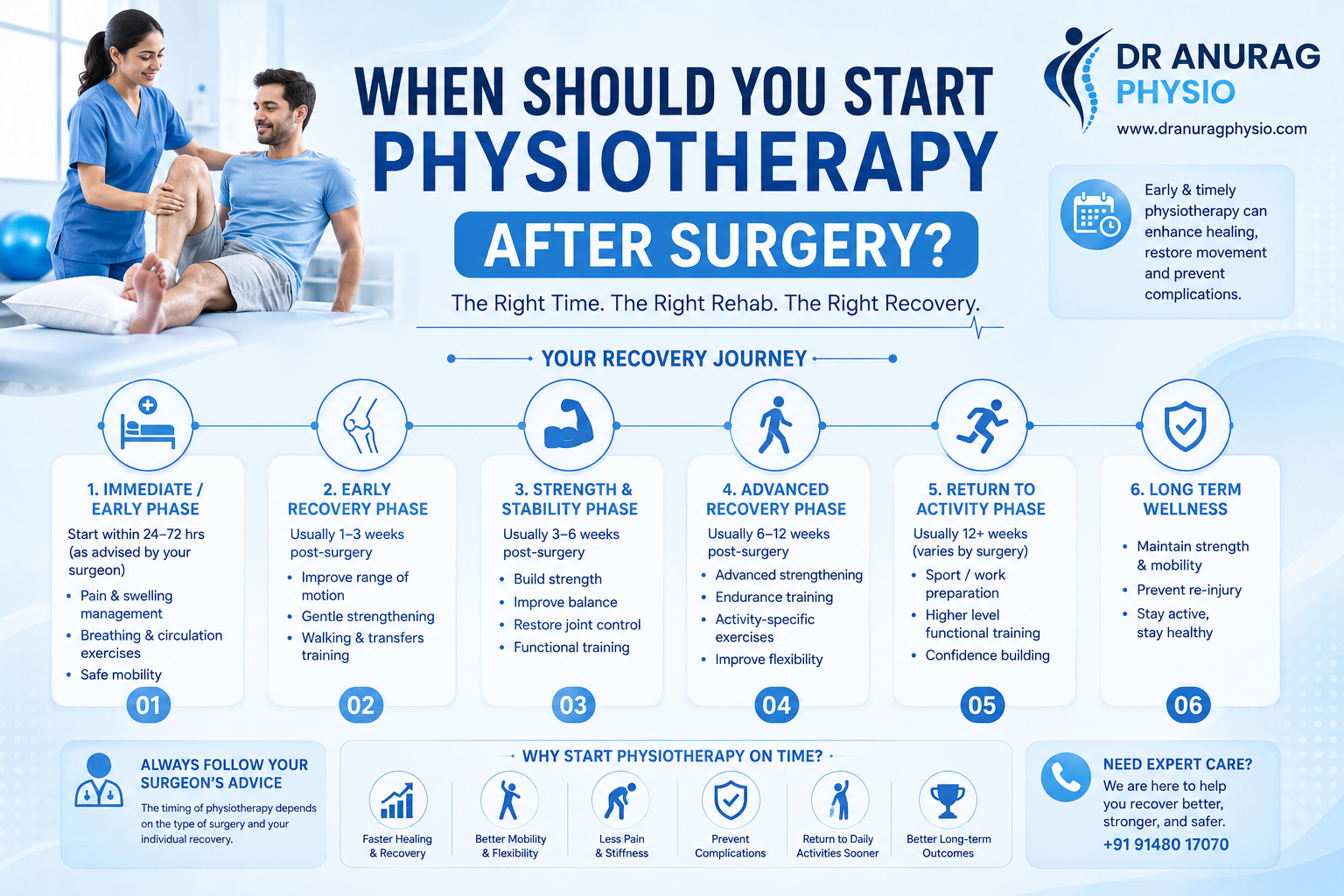
In many cases, physiotherapy after surgery can begin within days of an operation, but the exact timing depends on the type of surgery, the tissues involved, the surgeon’s instructions, your medical condition and your ability to move safely.
Book Appointment
For some procedures, rehabilitation begins while you are still in the hospital. For others, the surgeon may recommend waiting until the wound or repaired tissue reaches a particular stage of healing.
The important question is therefore not simply:
“How many days after surgery should I start physiotherapy?”
It is:
“What type of movement and rehabilitation is safe for my specific surgery at this stage of recovery?”
Early rehabilitation may focus on safe movement, swelling control, breathing exercises, circulation, basic mobility and preventing unnecessary stiffness. Later stages usually progress toward strength, balance, functional movement and return to normal activities.
Dr Anurag Physio provides structured post operative physiotherapy programs based on the patient’s surgery, recovery stage, functional limitations and rehabilitation goals. The clinic’s current post-surgical rehabilitation page describes a progression from pain and swelling control through mobility, strength and functional recovery.
Why Is Physiotherapy Important After Surgery?
Surgery addresses the underlying problem, but the body may still need rehabilitation to regain normal movement and function.
After surgery, it is common to experience:
- Pain and swelling
- Muscle weakness
- Reduced joint movement
- Stiffness
- Difficulty walking
- Reduced balance
- Loss of strength after inactivity
- Fear of movement
- Difficulty returning to work, exercise or sports
Appropriate rehabilitation can help you progressively regain:
- Mobility
- Muscle strength
- Joint control
- Balance
- Coordination
- Functional independence
- Confidence with movement
The rehabilitation plan should always respect the restrictions associated with your particular surgery.
When Can Physiotherapy Start After Surgery?
There is no single start date that applies to every operation.
1. Immediately or Within the First Few Days
For some surgeries, physiotherapy begins very early.
The initial program may involve:
- Bed mobility
- Safe transfers
- Breathing exercises
- Circulation exercises
- Gentle movement
- Walking with appropriate support
- Positioning education
- Basic muscle activation
The purpose at this stage is not to perform intense exercise.
It is to promote safe recovery while protecting the operated area.
2. During the Early Recovery Phase
As the surgeon permits more movement, physiotherapy may progress toward:
- Improving range of motion
- Reducing stiffness
- Restoring basic muscle activation
- Improving walking
- Gradually increasing daily activity
- Managing swelling
- Improving confidence with movement
The exact exercises depend on the operation.
For example, rehabilitation after a knee replacement is different from rehabilitation after ACL reconstruction, shoulder surgery or spinal surgery.
3. Intermediate Rehabilitation
Once healing allows greater loading, rehabilitation may focus on:
- Progressive strengthening
- Joint mobility
- Balance
- Coordination
- Functional movements
- Stair training
- Walking endurance
- Postural control
This stage is particularly important because pain may improve before strength and movement capacity have fully returned.
4. Advanced Rehabilitation
For active individuals and athletes, later rehabilitation may involve:
- Progressive resistance training
- Running preparation
- Jumping
- Landing mechanics
- Agility
- Sport-specific drills
- Endurance conditioning
- Return-to-work activities
- Return-to-sport testing
This is where general physiotherapy can transition into more specialised sports rehabilitation.
Does Every Surgery Require Physiotherapy?
No.
The need for physiotherapy depends on the procedure, the patient’s condition and the recovery goals.
Physiotherapy is commonly considered after procedures involving:
- Knee replacement
- Hip replacement
- ACL reconstruction
- Meniscus surgery
- Ligament repair
- Fracture fixation
- Shoulder surgery
- Rotator cuff repair
- Spine surgery
- Certain foot and ankle surgeries
- Other orthopedic procedures
Some minor procedures may require little formal rehabilitation.
The surgeon and physiotherapist can determine whether supervised rehabilitation is appropriate.
Why Starting Physiotherapy Too Early Can Be a Problem
Early rehabilitation can be beneficial, but earlier is not automatically better.
Some tissues need protection after surgery.
Starting unrestricted exercises before the surgeon’s restrictions are understood may potentially:
- Stress a repaired structure
- Increase pain or swelling
- Interfere with healing
- Delay recovery
- Cause unnecessary complications
For this reason, your physiotherapist should know:
- What surgery was performed
- When it was performed
- Whether any tissue was repaired or reconstructed
- Your weight-bearing restrictions
- Your movement restrictions
- Any brace or support requirements
- The surgeon’s rehabilitation protocol
- Any complications that occurred
A personalised plan is safer than copying exercises from another patient’s recovery.
What Happens During the First Physiotherapy Session After Surgery?
Your first session may be more assessment-focused than exercise-focused.
A physiotherapist may review:
Surgical information
The therapist needs to understand what procedure was performed and what structures were involved.
Pain and swelling
The severity and behaviour of symptoms can help determine what activity is appropriate.
Mobility
The physiotherapist may assess how well you can move the affected area within the permitted range.
Strength
Early weakness is common after surgery and may be evaluated gradually.
Walking and transfers
For lower-limb procedures, safe movement between sitting, standing and walking may be important.
Functional limitations
The therapist may ask what activities you currently cannot perform.
Recovery goals
Your rehabilitation plan should reflect your actual goals—for example:
Walking independently → returning to work → climbing stairs → gym training → returning to sport
What Does Post Operative Physiotherapy Include?
Post operative physiotherapy is not one fixed treatment.
Depending on the procedure and recovery stage, it may include:
Pain and Swelling Management
Your physiotherapist may recommend appropriate positioning, movement and other clinically suitable strategies to help manage post-operative symptoms.
Mobility Exercises
Controlled movement can help address stiffness while respecting surgical restrictions.
Muscle Activation
After surgery, muscles may become inhibited or weaker because of pain and reduced activity.
Progressive Strengthening
Strengthening usually becomes more demanding as healing progresses.
Balance Training
Balance may be affected by weakness, pain, altered walking patterns or reduced activity.
Functional Rehabilitation
Exercises can gradually become more similar to everyday activities.
Return-to-Sport Rehabilitation
Athletes may require additional strength, power, agility and sport-specific conditioning before returning to full participation.
Dr Anurag Physio’s current rehabilitation approach describes individualised programs, progressive strength training and monitoring of recovery milestones.
Physiotherapy After Common Orthopedic Surgeries
After Knee Replacement
Rehabilitation commonly focuses on:
- Knee movement
- Walking
- Strength
- Swelling management
- Stair function
- Balance
- Progressive daily activity
The exact progression depends on the patient’s surgical and medical status.
After ACL Reconstruction
Rehabilitation is usually staged over an extended period.
Early priorities can include:
- Swelling control
- Knee movement
- Muscle activation
- Safe walking
Later stages may progress toward:
- Strength
- Single-leg control
- Running
- Jumping
- Agility
- Sport-specific preparation
Returning to competitive sport should not be based solely on the number of weeks since surgery.
After Shoulder Surgery
Rehabilitation may initially focus on protecting the repaired structures while maintaining appropriate movement.
Later stages can involve:
- Range of motion
- Shoulder strength
- Scapular control
- Functional movements
- Overhead activities
- Sport-specific exercises
The permitted movements depend heavily on the specific operation.
After Fracture Surgery
Rehabilitation may address:
- Joint stiffness
- Muscle weakness
- Weight-bearing progression
- Walking
- Balance
- Functional strength
Weight-bearing restrictions should be followed carefully.
Can You Start Sports Physiotherapy After Surgery?
Yes, but sports rehabilitation usually comes later in the recovery process unless the surgical protocol specifically allows sport-related conditioning earlier.
People looking for sports physiotherapy bangalore after surgery should understand that sports rehabilitation is not simply a faster version of normal physiotherapy.
The athlete must progressively demonstrate the capacity to handle the physical demands of their sport.
Depending on the sport, this may involve:
- Strength testing
- Single-leg control
- Running
- Acceleration
- Deceleration
- Jumping
- Landing
- Cutting
- Agility
- Endurance
- Sport-specific drills
Dr Anurag Physio currently offers sports injury rehabilitation and describes programs involving strength, mobility, movement correction and return-to-sport rehabilitation.
When Should Athletes Start Sports Rehabilitation After Surgery?
The answer depends on the surgery and the surgeon’s protocol.
For an athlete, rehabilitation can often be viewed as a progression:
Protection → Mobility → Strength → Control → Functional Loading → Running → Sport-Specific Training → Return to Sport
Trying to skip stages can increase the challenge placed on recovering tissues before adequate capacity has been rebuilt.
This is especially important for athletes recovering from ligament reconstruction, muscle injury or other orthopedic procedures.
What If You Have Pain During Rehabilitation?
Some discomfort can occur during recovery, but not every type of pain should be ignored.
Tell your physiotherapist if you experience:
- Increasing pain
- Increasing swelling
- Sudden loss of movement
- New weakness
- Significant changes in sensation
- Increasing redness or wound concerns
- Fever or other signs of illness
- New calf pain or swelling
- Shortness of breath or chest pain
Some of these symptoms may require medical assessment rather than simply modifying an exercise.
When Should You Contact Your Surgeon?
Contact your surgical team when you experience symptoms that fall outside your expected recovery instructions.
Depending on your surgery, this may include:
- Wound problems
- Significant bleeding
- Increasing redness or discharge
- Fever
- Sudden severe pain
- New or worsening swelling
- New neurological symptoms
- Unexpected loss of function
Emergency symptoms such as severe breathing difficulty, chest pain or sudden severe neurological symptoms require urgent medical attention.
What If You Have Other Pain While Recovering From Surgery?
Not every symptom after surgery necessarily comes from the surgical site.
For example, reduced activity and altered movement may contribute to discomfort elsewhere.
Some people may search for treatment because they have:
- pain in feet and calves
- neck and lower back pain together
- Muscle stiffness
- General weakness
- Walking difficulty
These symptoms should be assessed in context rather than automatically attributed to the surgery.
For example, new calf pain or swelling after surgery can have causes that require medical assessment, so it should not simply be treated as routine muscle soreness.
Can Physiotherapy Help After a Sports Injury and Surgery?
Yes, rehabilitation may be especially important when surgery follows a sports injury.
A structured program can help bridge the gap between:
Surgical recovery → normal movement → strength → sports performance
For athletes, the goal is not simply to feel better.
The body must progressively regain the physical capacity required for the sport.
This is why sports rehabilitation often includes functional and sport-specific testing before unrestricted participation.
What Is a Sports Hernia?
A sports hernia is commonly used to describe exercise-related groin pain associated with injuries involving the abdominal wall or structures around the pubic region. The terminology can be confusing because it does not necessarily mean a traditional abdominal-wall hernia.
Commonly reported sports hernia symptoms can include:
- Groin pain
- Pain during sprinting
- Pain with twisting
- Pain during kicking
- Discomfort during cutting movements
- Pain that improves with rest but returns with sports activity
Persistent groin pain should be assessed by an appropriately qualified healthcare professional because several conditions can produce similar symptoms.
A physiotherapist can contribute to rehabilitation once the diagnosis and appropriate medical management have been established.
Can an Exercise Doctor and Physiotherapist Work Together?
Yes.
An exercise doctor or sports medicine physician may assess the medical aspects of an athlete’s condition, while a physiotherapist may develop and supervise the rehabilitation program.
Depending on the injury, successful recovery may involve collaboration between:
- Surgeon
- Sports medicine physician
- Physiotherapist
- Strength and conditioning professional
- Coach
- Other relevant healthcare professionals
This multidisciplinary approach can be particularly valuable for athletes returning after significant injuries or surgery.
Hamstring Problems After Surgery or Sports Injury
Some athletes begin rehabilitation after surgery with additional muscle problems caused by reduced activity or altered movement.
If you are searching for hamstring strain recovery time or pulled hamstring recovery time, remember that there is no single recovery duration for every hamstring injury.
Recovery depends on factors such as:
- Severity of the strain
- Location of the injury
- Strength deficit
- Previous hamstring injuries
- Running demands
- Rehabilitation progression
- Return-to-sport requirements
Returning to sprinting before adequate strength and load tolerance have returned may increase the risk of recurrence.
Physiotherapy in Whitefield for Post-Surgical Rehabilitation
Patients searching for physiotherapy in Whitefield may require rehabilitation after orthopedic surgery, sports injury or joint problems.
Dr Anurag Physio currently lists Whitefield among the Bangalore areas it serves and provides post-surgical and orthopedic rehabilitation services. The clinic also lists centres in Mahadevapura and Varthur.
For the most appropriate clinic location and current appointment availability, patients should contact the practice directly.
Phone: +91 91480 17070
How to Choose the Best Physiotherapist After Surgery
Instead of choosing a provider based only on claims such as best sports physiotherapist in Bangalore, consider whether the physiotherapist:
- Has relevant clinical experience
- Understands your type of surgery
- Works with your surgeon’s restrictions
- Performs an individual assessment
- Uses progressive rehabilitation
- Tracks functional progress
- Explains what you can and cannot do
- Has experience with your activity or sport when relevant
- Communicates clearly with other healthcare professionals when necessary
The right physiotherapist is not necessarily the one promising the fastest recovery.
A good rehabilitation program should prioritise safe, measurable and sustainable progress.
Why Choose Dr Anurag Physio for Post-Surgical Rehabilitation?
Dr Anurag Physio describes its approach as evidence-based sports and orthopedic rehabilitation with personalised treatment plans. The clinic’s current website highlights clinical assessment, individualised rehabilitation, supervised sessions and progress tracking.
Experienced Physiotherapy Care
Dr Anurag Gupta is presented on the clinic website as a Consultant Physiotherapist with 10+ years of clinical experience in orthopedic physiotherapy, sports rehabilitation, musculoskeletal care and movement restoration. The website also states 1000+ successful recoveries. These figures should be periodically verified before publication or reuse.
Book Appointment
Individualised Rehabilitation
Recovery plans are adjusted according to the patient’s surgery, current function, restrictions and goals rather than using the same program for every patient.
Progressive Recovery
The rehabilitation approach progresses from basic recovery needs toward mobility, strength, functional activity and, where appropriate, sports performance.
Sports and Orthopedic Expertise
The clinic provides sports injury rehabilitation and orthopedic physiotherapy, making it relevant for patients whose surgery followed an athletic or musculoskeletal injury.
Meet Dr Anurag Gupta
Dr Anurag Gupta
Consultant / Senior Physiotherapist | Bangalore
Clinical areas include:
- Orthopedic physiotherapy
- Post-surgical rehabilitation
- Sports rehabilitation
- Sports injury recovery
- Musculoskeletal rehabilitation
- Movement restoration
- Return-to-sport rehabilitation
Dr Anurag Gupta is identified by the clinic as a physiotherapist specialising in sports and orthopedic rehabilitation. The current website states 10+ years of clinical experience and 1000+ successful recoveries.
Practice: Dr Anurag Physio
Phone: +91 91480 17070
Location: Bangalore, Karnataka