Running can be one of the simplest ways to stay active, but repeated impact and sudden increases in training can place considerable demands on the muscles, tendons, joints and bones.
A runner may start with a minor ache and continue training until it becomes difficult to run, climb stairs or even walk comfortably.
Sports physiotherapy for runners focuses on more than treating pain. A structured program can help identify contributing factors, restore strength and movement, gradually rebuild running capacity and support a safe return to training.
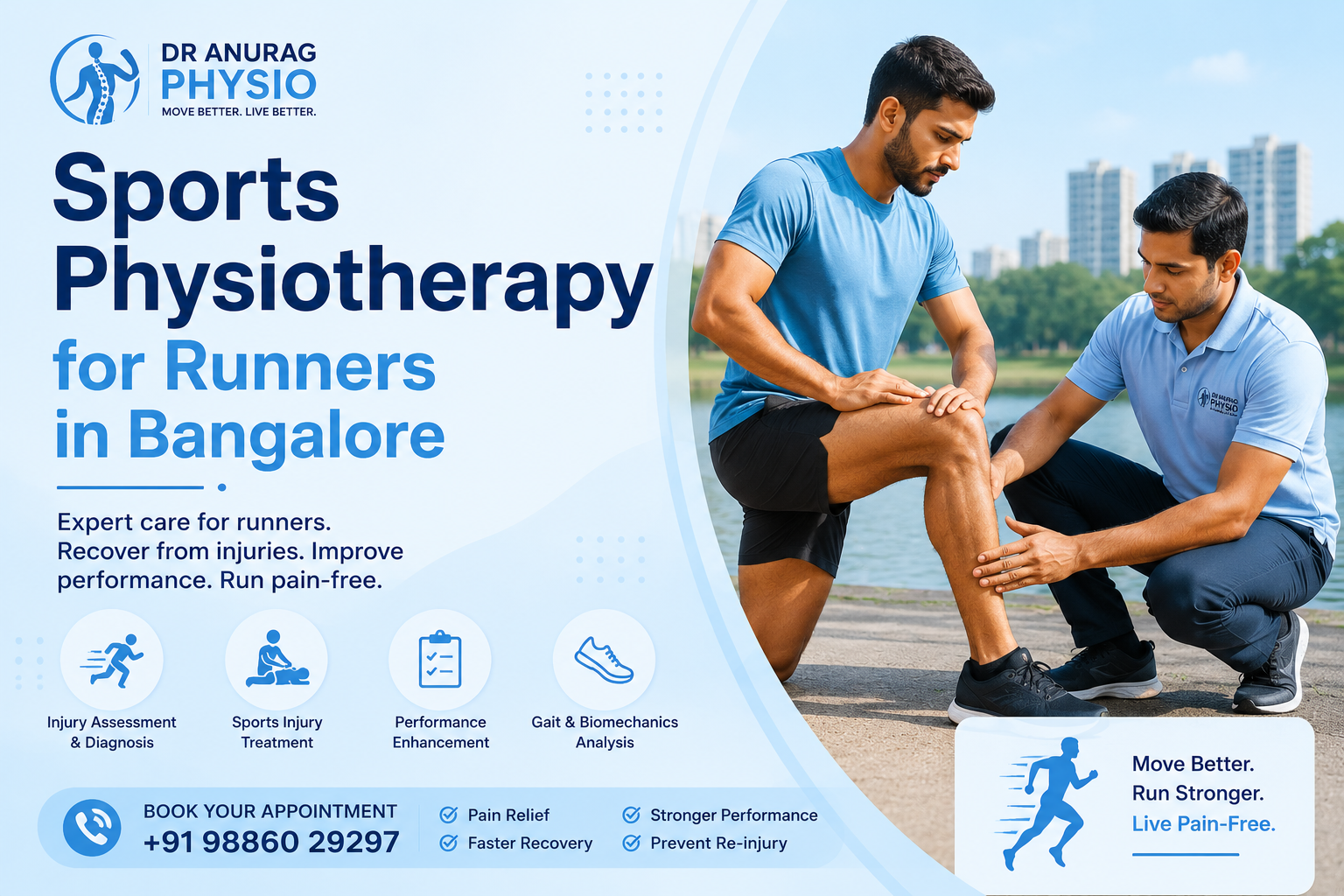
Dr Anurag Physio provides sports and orthopedic physiotherapy in Bangalore, including rehabilitation for sports injuries and movement-related problems. The practice describes personalised rehabilitation based on assessment, individual goals and functional requirements.
Book Appointment
Quick Answer
If running pain is affecting your training, a sports physiotherapy assessment can help determine what may be contributing to the problem and whether you need rehabilitation, training modification or medical evaluation.
Depending on your condition, treatment may include:
- Injury assessment
- Movement assessment
- Strength testing
- Mobility work
- Running-related functional assessment
- Progressive strengthening
- Load management
- Balance and coordination training
- Return-to-running rehabilitation
- Injury-prevention strategies
The goal is to help you return to running safely—not simply to make the pain disappear temporarily.
Why Do Runners Get Injured?
Running injuries can develop for several reasons.
A common misconception is that every running injury is caused by poor running form.
In reality, injury risk can be influenced by multiple factors.
Sudden Training Changes
Increasing distance, speed, hills or training frequency too quickly can increase physical load.
Insufficient Recovery
Your body needs time to adapt to training.
Poor sleep, inadequate recovery and excessive training can affect your ability to tolerate workload.
Muscle Weakness
Insufficient strength in the hips, thighs, calves or trunk can affect your ability to tolerate running demands.
Previous Injury
A previous injury may affect movement or training tolerance even after pain has improved.
Training Surface
Changes in terrain or surface can alter the demands placed on your body.
Footwear
Shoes can influence comfort and running experience, although footwear alone does not explain most running injuries.
Training Errors
Common examples include:
- Increasing mileage rapidly
- Adding speed work suddenly
- Introducing hills too quickly
- Running too many consecutive days
- Returning to running immediately after injury
Common Running Injuries Treated With Physiotherapy
Runners can experience different types of musculoskeletal problems.
Runner’s Knee
Pain around or behind the kneecap can affect runners, particularly when training volume or load changes.
Rehabilitation may focus on strength, movement control, training modification and gradual return to running.
Shin Splints
Shin pain is commonly associated with increased running load and other contributing factors.
Treatment may include load management, strengthening and gradual training progression.
Plantar Fasciitis
Heel or foot pain can interfere significantly with running.
Rehabilitation may address calf and foot strength, mobility, loading and running progression.
Achilles Tendon Pain
The Achilles tendon experiences significant load during running.
Rehabilitation often requires carefully progressed loading rather than simply resting until pain disappears.
IT Band-Related Pain
Pain around the outside of the knee or thigh can occur in runners.
A physiotherapist can assess strength, movement, training load and other contributing factors.
Hamstring Injuries
Hamstring strains may occur during sprinting, speed work or other high-load activities.
Returning to running too quickly can increase the risk of recurrence.
Running Injury Physiotherapy Bangalore
If you are searching for running injury physiotherapy Bangalore, the first step should be determining what is causing your symptoms.
Your physiotherapist may assess:
- Pain location
- Pain behaviour
- Joint mobility
- Muscle strength
- Balance
- Running-related movement
- Training volume
- Training intensity
- Previous injuries
- Recovery habits
- Functional limitations
The assessment helps determine whether your problem is appropriate for physiotherapy and how your training should be modified.
Dr Anurag Physio provides sports and orthopedic physiotherapy for sports injuries and musculoskeletal conditions in Bangalore.
Running Injury Treatment Bangalore
Running injury treatment Bangalore should not mean simply stopping running until the pain disappears.
Depending on the injury, rehabilitation may involve:
Assessment → Load modification → Symptom management → Strength → Running progression → Return to training
For some injuries, temporary reduction in running may be necessary.
For others, carefully modified running can be incorporated into rehabilitation.
Your physiotherapist can help determine the appropriate approach.
Running Physiotherapy Bangalore: What Does Treatment Include?
Running physiotherapy Bangalore can involve several components.
1. Clinical Assessment
Your physiotherapist first identifies the nature and severity of your symptoms.
2. Strength Assessment
The strength and endurance of muscles important for running may be evaluated.
3. Mobility Assessment
Relevant joint and muscle movement may be assessed.
4. Training Load Review
Your recent training history can reveal whether there has been a sudden increase in workload.
5. Exercise Rehabilitation
A progressive exercise program may target:
- Calves
- Quadriceps
- Hamstrings
- Glutes
- Hip muscles
- Core
- Foot and ankle
6. Running Progression
Once appropriate, running can gradually be reintroduced or progressed.
7. Return-to-Sport Planning
The final objective is to help you return to your desired level of running.
Physiotherapy for Runners: What Makes It Different?
Physiotherapy for runners should consider the demands of running rather than treating the painful body part in isolation.
For example, someone with knee pain may also have relevant factors involving:
- Hip strength
- Calf capacity
- Training load
- Running volume
- Recovery
- Previous injuries
- Movement control
The rehabilitation program should therefore consider the entire kinetic chain and the demands of running.
Sports Physiotherapy for Runners
Sports physiotherapy for runners can help address both injury rehabilitation and performance-related physical preparation.
Depending on the runner’s goals, treatment may include:
Injury Rehabilitation
Recovering from:
- Knee injuries
- Calf strains
- Hamstring injuries
- Achilles problems
- Foot injuries
- Shin pain
- Hip injuries
Strength Development
Building strength and endurance required for running.
Mobility
Addressing relevant movement restrictions.
Running Load Management
Gradually adjusting training volume and intensity.
Return to Running
Creating a progressive pathway from rehabilitation to normal training.
Injury Prevention
Identifying modifiable factors that may increase injury risk.
Sports Physiotherapist Bangalore: When Should You See One?
A sports physiotherapist Bangalore service may be appropriate when:
- Pain repeatedly returns during running
- You have stopped running because of pain
- Your performance has declined
- You are recovering from an injury
- You are preparing for a race
- You are returning after surgery
- You want help managing training load
- You are concerned about recurrent injuries
- You want sport-specific rehabilitation
You don’t necessarily need to wait until an injury becomes severe.
Early assessment can sometimes help identify a problem before it significantly interrupts your training.
Sports Physiotherapy Near Me for Runners
People searching for sports physiotherapy near me often want a nearby professional who understands athletic injuries.
When choosing a sports physiotherapy provider, look for:
- Experience with sports injuries
- Individual assessment
- Exercise-based rehabilitation
- Progressive loading
- Return-to-sport planning
- Appropriate referral when necessary
- Clear communication about recovery expectations
The nearest clinic is not necessarily the best choice if it does not provide the type of rehabilitation you need.
Running Injury Physiotherapy Near Me
If you are searching for running injury physiotherapy near me, consider seeking assessment when pain:
- Persists despite reducing training
- Returns every time you run
- Changes your running pattern
- Limits walking
- Affects stairs
- Causes swelling
- Is associated with weakness
- Prevents normal training
Don’t repeatedly train through worsening pain simply because you have an upcoming race.
Running Injury Assessment: What Should Be Checked?
A runner’s assessment may include more than examining the painful area.
Depending on the problem, your physiotherapist may consider:
Training History
- Weekly mileage
- Running frequency
- Speed sessions
- Hill training
- Long runs
- Recent training changes
Strength
- Calf strength
- Quadriceps strength
- Hamstring strength
- Hip strength
- Trunk control
Mobility
- Ankle movement
- Hip movement
- Knee movement
- Relevant soft-tissue flexibility
Functional Movement
You may be assessed during activities such as:
- Squatting
- Lunging
- Single-leg balance
- Step-downs
- Jumping
Running
Where appropriate, running mechanics and movement may be observed.
How Training Load Affects Running Injuries
Training load is one of the most important factors to consider.
For example, an injury may occur after:
Normal training → Sudden mileage increase → Additional speed work → Reduced recovery → Pain
This does not necessarily mean the runner’s technique is “wrong.”
The body may simply have been exposed to more load than it could currently tolerate.
A rehabilitation program should therefore consider both capacity and workload.
How to Return to Running After an Injury
Returning to running should be progressive.
A general rehabilitation pathway may look like:
Stage 1 — Symptom Management
Reduce aggravating activities while maintaining suitable movement.
Stage 2 — Restore Capacity
Build strength, mobility and tolerance.
Stage 3 — Introduce Running
Start with an appropriate volume and intensity.
Stage 4 — Progress Gradually
Increase running demands according to your response.
Stage 5 — Return to Normal Training
Gradually reintroduce:
- Distance
- Speed
- Hills
- Intervals
- Long runs
Avoid increasing every training variable simultaneously.
Your physiotherapist can help create an individualised progression.
Can You Run While Recovering From an Injury?
Sometimes yes, depending on the injury.
Complete rest is not automatically necessary for every running injury.
In some cases, your physiotherapist may recommend:
- Reduced mileage
- Slower running
- Run-walk intervals
- Fewer training days
- Removal of speed sessions
- Avoiding hills temporarily
In other cases, running may need to stop temporarily.
The appropriate decision depends on the injury and your clinical assessment.
Strength Training for Runners
Strength training can be an important part of rehabilitation and performance preparation.
Exercises may target:
Calves
Important for propulsion and repeated loading.
Quadriceps
Important for controlling the knee and absorbing load.
Hamstrings
Important for hip and knee function.
Glutes
Important for hip control and running-related force production.
Foot and Ankle
Important for stability and load tolerance.
Core
Important for trunk control during movement.
Strength training should be progressed according to your current capacity rather than simply following an advanced runner’s program.
Running Injury Prevention
No strategy can guarantee that a runner will never get injured.
However, several practical principles may help:
Increase Training Gradually
Avoid sudden jumps in mileage or intensity.
Allow Recovery
Include adequate recovery between demanding sessions.
Strength Train
Maintain strength throughout the training cycle.
Don’t Ignore Persistent Pain
Repeatedly running through worsening pain can make it harder to identify the underlying problem.
Vary Training
Avoid making every run high intensity.
Prepare for Race Demands
Training should progressively expose your body to the demands of your event.
Marathon Preparation and Physiotherapy
Runners preparing for a marathon may benefit from physiotherapy support even if they are not currently injured.
A sports physiotherapist can potentially help with:
- Training-load management
- Strength assessment
- Previous injury management
- Mobility
- Recovery planning
- Race preparation
- Return-to-running progression
This can be particularly useful when training volume increases significantly.
When Running Pain Is Not a Normal Training Ache
Some soreness after a new or demanding workout can be temporary.
However, seek assessment if you experience:
- Persistent pain
- Increasing pain during runs
- Pain that changes your gait
- Significant swelling
- Weakness
- Repeated injury in the same area
- Pain that does not improve with appropriate load modification
- Pain at rest or at night that is unexplained
A sports physiotherapist can determine whether rehabilitation is appropriate or whether medical evaluation is required.
Red Flags Requiring Medical Assessment
Running-related pain should not automatically be treated as a sports injury.
Seek prompt medical assessment for:
- Major trauma
- Inability to bear weight
- Significant swelling after injury
- Severe or rapidly worsening pain
- New neurological symptoms
- Significant weakness
- Unexplained fever with severe pain
- Suspected fracture
Chest pain, severe breathing difficulty or other emergency symptoms require urgent medical attention.
How Dr Anurag Physio Helps Runners
Dr Anurag Physio provides sports and orthopedic physiotherapy in Bangalore.
Its sports rehabilitation approach includes assessment and progressive rehabilitation for sports-related musculoskeletal problems.
Depending on your condition and goals, rehabilitation may include:
- Injury assessment
- Mobility work
- Strength training
- Functional rehabilitation
- Balance training
- Load management
- Return-to-sport progression
- Home exercise programs
The practice describes its approach as personalised and evidence-informed rather than using identical treatment for every athlete.
Why Choose Dr Anurag Physio for Running Rehabilitation?
Sports and Orthopedic Focus
The practice provides sports rehabilitation alongside orthopedic and musculoskeletal physiotherapy.
Individual Assessment
Treatment is based on your symptoms, physical findings, activity level and goals.
Progressive Exercise
Rehabilitation can progress from basic movement and strength toward sport-specific requirements.
Return-to-Running Focus
The objective can extend beyond symptom reduction toward restoring the physical capacity required for running.
Bangalore Locations
Dr Anurag Physio currently operates centres in Mahadevapura and Varthur, with services also available across multiple Bangalore areas.
Phone: +91 91480 17070
Book Appointment
Meet Dr Anurag Gupta
Dr Anurag Gupta
Lead Physiotherapist | Sports & Orthopedic Rehabilitation
Dr Anurag Physio identifies Dr Anurag Gupta as its lead physiotherapist, with a clinical focus that includes sports rehabilitation, orthopedic physiotherapy, musculoskeletal rehabilitation and post-surgical rehabilitation.
The practice currently states 10+ years of clinical experience and 1,000+ successful recoveries on its website. These figures should be kept updated and independently verifiable on the live website. (dranuragphysio.com)
Practice: Dr Anurag Physio
Location: Bangalore, Karnataka
Phone: +91 91480 17070